
4 Ways to Tune a Guitar by Ear
What is tuning your guitar “by ear”?
Tuning by ear means adjusting the strings according to what you hear. It’s an alternative to using a digital guitar tuner.
Digital tuners are helpful, particularly in a noisy environment. Or when we have new strings. But they can run out of batteries or get lost. Knowing how to tune without one means we can be confident our guitar will always sound great.
There are other benefits too. By listening carefully to how strings sound together, we develop a better musical ear. Tuning becomes faster and easier. And we deepen our connection to our instrument.
A Quick Guide: Tuning by Ear
This guide explores four ways to tune by ear:
- 5th Fret Method: The standard approach where you match each string to the 5th fret (usually) of the adjacent string
- Harmonics Method: Using natural harmonics at the 5th and 7th frets to tune strings against each other
- Tuning Fork Method: Using a reference tone (typically A=440Hz) to establish one string, then tuning others from it
- Reference Note Method (Octaves): Tuning all strings to match octaves from a single, accurately tuned string
Table of Contents
- How to Tune a Classical Guitar
- How to Tune with a Digital Turner (or App)
- Tune by Ear Using the 5th Fret Method
- Tune with Harmonics (Including the Tuning Fork Method)
- How to Tune with a Reference Note
Many beginner guitarists think it’s an occasional chore to tune their guitar strings. Maybe once or twice a week will do it.
But as our ear develops, we’re more able to discern “in” tune from “out”. We might want to retune several times per practice. At the very least, we’ll want to tune at the beginning of every practice.
Luckily, there are many ways we can tune a classical guitar (or acoustic and electric guitars). It sets the stage for a great practice. In time, tuning your guitar strings will feel natural, and you’ll do it without thinking.
Any tuning method that gets you there is a good one. Each tool and tuning method has its strong and weak points. Each takes a little time to get used to. But if you can tune a guitar by ear, it won’t matter if you leave your tuning tools behind.
How to Tune a Classical Guitar
Knowing how to tune a guitar properly is important if we want to sound good. There is no special “classical guitar tuner” or method. We use the same process as we would for an acoustic or electric guitar.
We tune most classical guitars to standard guitar tuning. So we’ll use this for each of the methods below.
In standard guitar tuning, the strings are tuned to the notes: E A D G B E (low to high sounding). There are alternate tunings, but standard tuning is most common on classical guitar.
You may find it a bit easier to tune a classical guitar by ear than a steel-string guitar. The nylon strings have a strong, “fat” sound that lets us hear the tuning. (The downside is that other people can also hear when it’s out of tune! But this is true for any guitar.)
All part of the game
The most important thing to remember when tuning a classical guitar is that this is part of the ritual. It’s part of the game.
As you sit down to practice, you can use tuning time to get into the best mental space. You can relax your face. (We hear better with a relaxed jaw.) You can put your attention on feeling the nylon strings and hearing the guitar sounds.
This focused awareness will lead to a better overall classical guitar practice.:
How to Tune Your Guitar with a Digital Tuner (or App)
If you’re a beginner, you’ll find it easiest to tune your guitar with an electronic tuner or app. There are many apps, both free and paid, available for iOS and Android. And there are also some free online guitar tuner websites.
Each app or device has its own special design. Sometimes there’s a backlight that changes color. But most likely, you’ll see arrows before and after the letter-name of the string being tuned. Your goal is to get the arrows on each side balanced.
Here’s how:
- Play an open string.
- Experiment by turning the tuning peg in either direction.
- Line up the arrows or lights on the tuner.
Things to remember:
Make sure you see the letter name of the string you’re tuning on the electronic tuner or app. (As a reminder, letter names of the strings are E A D G B E, unless you’re in a different tuning.)
If it says a different note, you will tune your string to the wrong note. This usually only happens when our guitar is way off being in tune. For instance, if we’ve just changed the strings. In this case, we are better off finding an external reference note, like on a keyboard. This will help us get our string sounding somewhere close, and then we can fine-tune.
After you have successfully tuned with a tuner or app, go through the “tuning by ear” routine below. This will begin training your ear. It will only take a few seconds, and it will prove very helpful over time.
General Tips to Tune a Classical Guitar
- Always play the note that is already in tune first, then the note or string you’re tuning.
- Instead of tuning down to a note, detune the note below where you need to be, and come back up to the correct pitch. (i.e. Tune the guitar string from below the pitch, tuning up to it.) This helps the string stay in tune longer.
- Be confident. Don’t be afraid to twist those tuning pegs.
How to Tune by Ear Using the 5th Fret Method
This is the most common method of tuning your guitar by ear.
Click here for the PDF Tuning Diagrams, with 3 different methods.
With this method, we effectively “tune our guitar to itself”.
We are still tuning our guitar by ear. We tune one string to an external reference point, or we just decide that a given string is close enough. Then we tune the other strings from this starting point.
The end result is that the guitar should be in tune with itself. (It sounds “right”, but it may not be in tune with what the larger world considers “in tune”. More on this later.)
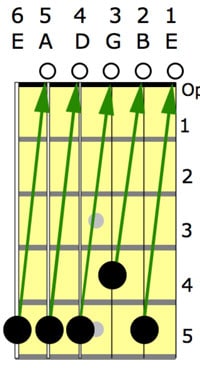
Here’s the process, assuming the 6th string (thickest string) is in tune to begin with:
- First play the 5th fret of the 6th string (low E string) and listen to it.
- Then play the open A string (5th string) and listen to it.
- Tune the open fifth string to match the pitch of the 5th fret of the 6th string.
Repeat as many times as it takes until you’re convinced that the fifth string is perfectly in tune. - Then…
Play the 5th fret on the fifth string and listen to it. - Then play the open D string (fourth string) and listen to it.
- Tune the open fourth string to match the pitch of the 5th fret of the fifth string.
- Repeat as many times as it takes until you’re convinced that the 4th string is perfectly in tune.
- Then…
Repeat the same process for the third string (open G string). Note: The G string is the first nylon string on a classical guitar. - When you tune the second string (B string), you need to first play the fourth fret (4th fret) of the third G string. (Not the 5th, like every other string.)
- Return to the 5th fret on the second string to tune the open first string.
How to Know It’s In Tune
As you tune your classical guitar, you can listen for two notes that are out of tune. There is a “warbling” sound when the strings are out of tune with each other. The two strings cause this warble by vibrating at different rates (i.e. different pitches).
The warble will slow as you approach the correct tuning. “Well in tune” sounds a steady pitch, with no warbling between the two notes.
Our ability to be able to hear this increases as we tune our guitar by ear more regularly. So listen for the warble while playing the strings. Your confidence to tune your guitar by ear will increase the more you do it.
How to Remember This:
To easily recall this method, just think: 55545
These are the frets to which you tune the adjacent open strings. Mind the 4th fret on the 3rd string!
The Downside
Although it’s considered to be the standard tuning pattern, this method is not perfect.
First, if our starting note is too far away from standard pitch, it will be hard to keep the guitar in tune. Each string has an ideal tension range where it stays in tune up and down the neck. When we tune too far away from standard pitch, we force the strings outside their ideal range. And nylon strings on classical guitars are especially prone to inconsistencies.
Also, this tuning method assumes that when an open string is playing in tune, the fifth fret will also be in tune. This sounds like a reasonable assumption. But depending on the guitar (or the individual nylon strings), this may or may not be true. (See below for more on “intonation”.)
We must trust and hope for the best. If you do everything right and your guitar still won’t play in tune, you may need to try another method. You could try changing your strings, or take your classical guitar to a technician and let them take a look.
Using Harmonics to Tune Your Guitar
You can also tune your guitar using harmonics. Like the method above, we tune one string to another, and that one to the next.
Click here for the PDF Tuning Diagrams, with 3 different methods.
The benefit of using harmonics is that our fretting hand is free. We can use it to turn the tuning keys while the notes continue to ring. This can make tuning your guitar quicker.
To tune your guitar using guitar harmonics, get one string in tune to an outside source. One option is a tuning fork. (More below on tuning using one of these.) You could also use a pitch on another instrument, such as a piano. Or you can use a pitch-pipe, or a tone from your computer or device.
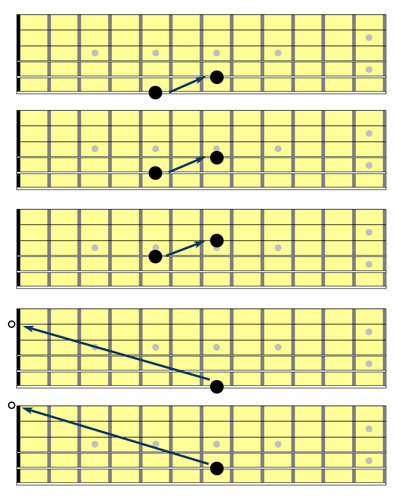
Here is the basic routine:
- Play the harmonic on the 5th fret of the sixth string (low E string) and listen.
- Play the harmonic on the 7th fret of the fifth string (A string), and listen to any difference between the two.
- Tune the fifth string until the pitch matches perfectly with that on the sixth string.
- Repeat this exactly for the fifth and fourth strings. (5th fret on the fifth string to the 7th fret on the fourth string.)
- Repeat this for the fourth (D) and third (G) strings. (5th fret on the fourth string to the 7th fret on the third string.)
- To tune the second string (the B string), first play the harmonic on the 7th fret of the sixth string. This is the same pitch as the open B string (no harmonic, just the open string).
- To tune the first string, first play the harmonic on the 7th fret of the fifth string. This note is the matching pitch of the open first string (no harmonic).
The Downsides of Tuning a Guitar with Harmonics
Like the 5th fret method above, this tuning technique can become a “game of telephone”. The final tuning might not be quite in tune with the first. However, because the first and second strings are tuned to the sixth and fifth, this is less of a problem.
Tuning using harmonics also assumes that your classical guitar’s intonation is perfect. This may not be true. The harmonic may not match the pitch you get when you fret and play the note. It might be slightly off. This happens frequently with nylon strings.
This method is also rather quiet, so if you are in a loud or busy place, you may have trouble hearing the harmonics.
How to Tune a Guitar Using a Tuning Fork
A normal tuning fork vibrates at 440 hertz/second. This vibration rate creates what we have agreed is the “A” pitch (or “la”, if you live in a Solfege country).
To tune your guitar to this pitch, match it to the harmonic on the 7th fret of the 4th string (D string).
You may also find tuners that vibrate to other notes. You’ll have to find a harmonic that matches those pitches. One common fork often sold to guitarists vibrates at an “E” (though I find A=440 easier to hear). For E, the matching harmonic is the 7th fret of the fifth string (A string).
How to Check Your Guitar’s Intonation
You can quickly check your intonation (pitch accuracy). Play the 12th fret harmonic on a chosen string, then press the 12th fret and play the actual note.
If there is a slight difference between the two, your intonation is off. Do this for each string, as some strings may be off while others are not.
If you find your intonation off, try changing your string. If you are still not happy, have a classical guitar technician or luthier take a look.
How to Tune a Guitar Using a Reference Note and Octaves (my favorite)
In addition to (and using) the methods above, you can also tune every string to a pre-chosen string.
Click here for the PDF Tuning Diagrams, with 3 different methods.
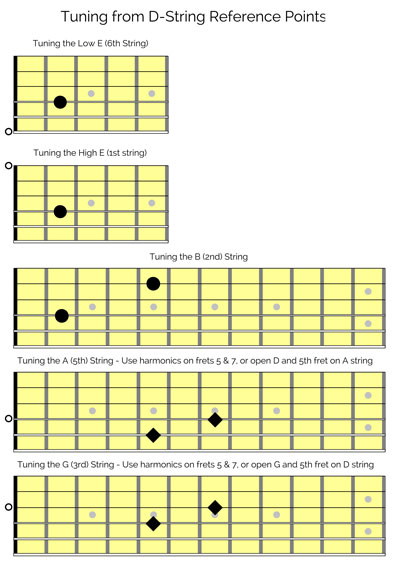
Personally, I find I can get “in tune” more quickly using this method. And the guitar is more in tune across the fretboard of the instrument.
This is opposed to being in tune in the first position, but less so up in the 7th or 9th position, which can sometimes happen.
Here’s the routine:
- Tune the fourth string (D string) to a tuning fork or other reference.
- Play the 2nd fret of the 4th string (the E note) and listen.
- Play the open 6th string (the low E string) and listen. These two notes are an octave apart, but you should be able to tell when they are in tune.
- Next, play the same note (2nd fret) on the fourth string and match it to the open first string. This note will be an octave higher (just as the 6th string was an octave lower).
- Then, play the same note (2nd fret) on the fourth string, and match it to the 5th fret of the 2nd string (B string). This note is also an E, and is also an octave higher.
- That just leaves the fifth and third strings (the open A string and open G string). You can tune these using either harmonics or the 5th fret method.
One advantage of this method is that we know that our initial note is in tune. (We used a tuner/app etc.) So we can reasonably assume that the other notes will be in tune once they’re matched to this one.

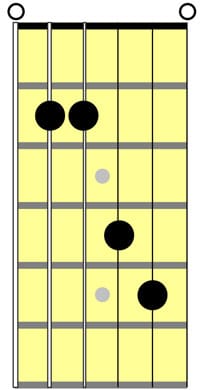
Are You in Tune? Use This Chord to Check
Once you have the guitar tuned, you can check your accuracy using the chord shown below (aka 022450). This chord is all E’s and B’s, so you can easily hear if one or more notes are not in perfect tune with the others.
Note: you will need to cover (bar) the fourth and fifth strings with your index finger, while allowing the highest string (E string) to ring. This means collapsing the tip joint on the index finger.
In Summing Up….
Have fun!
Click here for the PDF Tuning Diagrams, with 3 different methods.
Frequently Asked Questions
- What is tuning by ear?
Tuning by ear is the process of adjusting your guitar strings to the correct pitch without using electronic tuners or apps. Instead, you rely on your hearing to compare pitches between strings. - Is tuning by ear accurate?
Yes, tuning by ear can be very accurate. However, it depends on your ear training, listening environment, and experience. The skill improves with practice. Beginners may find it easier to use a tuner, and that’s fine. - How often should I tune my guitar?
Tune at the beginning of every practice session. As your ear develops, you may find yourself tuning several times during a practice. (Especially with nylon strings, which can shift in pitch more easily.) -
What’s that “warbling” sound when tuning?
The warbling or beating sound occurs when two notes are slightly out of tune with each other. The warbling slows down as the notes get closer to being in tune, and disappears completely when they match perfectly. - Why is my guitar still out of tune after following these methods?
This could be due to intonation issues, old strings, temperature changes, or humidity. Compare the 12th fret harmonic with the fretted 12th fret note on each string. If they sound different in pitch, try changing your strings. If the problem persists, consider having your guitar checked by a technician. -
What’s the easiest way to start tuning by ear?
Start with the 5th fret method as it’s most straightforward. Or you could use a digital tuner first, then practice the 5th fret method to train your ear. -
Why does the B string use the 4th fret instead of the 5th in the standard 5th fret method?
This is because the interval (pitch gap) between the G and B strings is different (a major third) from that between other adjacent strings (perfect fourths). -
Can I tune a classical guitar the same way as an acoustic or electric guitar?
Yes, the tuning process is the same for all guitars. Classical guitars use nylon strings, but the standard tuning remains E-A-D-G-B-E. - What’s the advantage of tuning using harmonics?
Harmonics ring out longer, freeing your fretting hand to adjust the tuning pegs while you can still hear the reference note. -
Should I tune up to a note or down to it?
It’s generally better to detune slightly below your target pitch, then tune up to it. This often helps your guitar stay in tune longer.

Hi, I’m Allen Mathews.
I started as a folk guitarist, then fell in love with classical guitar in my 20’s. Despite a lot of practice and schooling, I still couldn’t get my music to flow well. I struggled with excess tension. My music sounded forced. And my hands and body were often sore. I got frustrated, and couldn’t see the way forward. Then, over the next decade, I studied with two other stellar teachers – one focused on the technical movements, and one on the musical (he was a concert pianist). In time, I came to discover a new set of formulas and movements. These brought new life and vitality to my practice. Now I help guitarists find more comfort and flow in their music, so they play more beautifully.
Click here for a sample formula.
Those videos on practicing the piece were just awesome, Allen! I've always thought that learning songs might be something completely different than practicing exercises, but the way you teach it makes it much easier than I thought. I'm positive that joining the Woodshed has been the best investment I've ever done for learning the classical guitar. Thank you so much for these lessons.
~ Ulysses Alexandre Alves
-Ulysses Alexandre Alves
Allen: Just wanted you to know I have thoroughly enjoyed The Woodshed program. I'm in Level 1C and love how every part works together. It has improved my "general" playing already.
~ Lydia Chance
-Lydia Chance
“Success lies in relentless execution of the basics.”
Join the program that takes you from the beginning fundamentals to advanced mastery, so you…

- Move your hands safely and fluidly
- Enjoy fulfilling practices and meaningful work
- Play beautifully with expression and flow
Click the button to take a step towards an
organized, effective guitar practice. >>>