Dotted Notes in Music – How to Count Dotted Rhythms
What are dotted notes in music theory?
We can add a dot to any sort of note. When a note is dotted in music, the rhythm is changed.
The rule is that a dot adds half the note value to the written note. This formula holds for whole notes, half notes, quarters, and all other notes.
When we understand the dotted note formula, we can play our pieces in rhythm. We can also use a dotted rhythm to increase our technical skills and speed.
Dotted Notes in Music Rhythms
When we see a dot beside a note, we add time to the duration of the note.
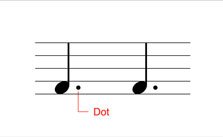
A dot beside a note changes the length of time we hold the note.
The dotted note formula is the original note plus one-half of the original.
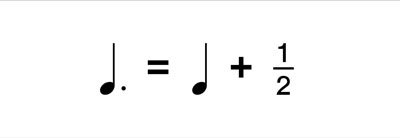
Dotted note formula: The dot adds half the note value to the duration.
For instance, a half note gets two beats. A dotted half note will get those two beats, plus half the value of two, which is one. So in total, this is three beats. 2 + 1 = 3. A dotted half note gets three beats.
Likewise, a dotted quarter note will get one beat plus half of one beat – or 1 and 1/2 beats. This could be a quarter note and an eighth note, or three eighth notes.
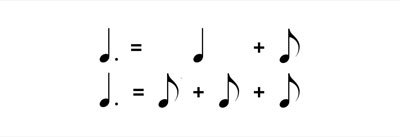
A dotted quarter gets 1 1/2 beats.
Note: Rests in music can also be dotted. And dotted notes (and rests) can’t go over a bar line. For that, we need a tied note.
The dot placement matters
A dot above or below the note means something else. Dotted notes where the dot is above or below the note head suggest that we play the notes short and separated. The musical term for this is stacatto. This is not a change in the note duration.
So for example, we still count the full duration of, say, a half note, but we don’t play it for the full duration. We stop it short to create a silence before the next note. The length of the silence can vary, but the silence and the note added together still create the duration of a half note.
For a note to be a dotted note rhythm, the dot will be beside the note head. The dot will always be to the right of the note. Never the left. This is true for all note values (half, quarter, etc.)
If the note is on a line, the dot will be to the right of the note, in the space above that line. If the note is in a space, the dot will be positioned in the same space.
How to Clap and a Count Dotted Note in Music
When we clap and count dotted rhythms, we hold the note for the full value. And we continue counting throughout.
For example, we may count two half notes as “1 2, 3 4.” Or “1 2, 1 2.” The claps land on 1 and 3, or 1 and 1, respectively.
For a dotted half and quarter, we still have a total of 4 beats. But the dotted note gets three and the quarter gets one. So “1 2 3, 4.” The clap lands on 1 and 4.
The total beats in each measure will stay consistent with the time signature for the piece.
Double Dotted Notes
In music theory, we can also find double dotted notes. This is where we see a note with two dots following it. This can look confusing, and in practice, we don’t come across them very often.
Double dotted notes are counted by adding the duration of the first dot, and then adding half the value of the first dot again to the note duration. Note that each dot has a different value.
So a double dotted quarter note would be a quarter, plus an 8th, plus a 16th.
Many thanks to MusicTheory.net for some of the images above.

Hi, I’m Allen Mathews.
I started as a folk guitarist, then fell in love with classical guitar in my 20’s. Despite a lot of practice and schooling, I still couldn’t get my music to flow well. I struggled with excess tension. My music sounded forced. And my hands and body were often sore. I got frustrated, and couldn’t see the way forward. Then, over the next decade, I studied with two other stellar teachers – one focused on the technical movements, and one on the musical (he was a concert pianist). In time, I came to discover a new set of formulas and movements. These brought new life and vitality to my practice. Now I help guitarists find more comfort and flow in their music, so they play more beautifully.
Click here for a sample formula.
Allen Mathews was recommended to me as somebody who could help me expand my guitar vocabulary. Allen started me on a really fun cycle of lessons and practice. He is a very good and very enthusiastic teacher, and I feel that I'm on the road to learning. I couldn't be more pleased with my experience.
~ Peter Buck (r.e.m.)
-Peter Buck, R.E.M.
Hi Allen,
Greetings from the UK. I would like to thank you for providing such an excellent resource. The effort and skill which has gone into creating this program is very evident. I started classical guitar a year or so ago with a teacher but was unable to commit to same time regular slots each week.The Woodshed Program was exactly what I was looking for. I have found the site very intuitive and well structured and have taken your advice and started from the very beginning of the program whilst still practising some of the pieces I was already working on. It is clear that I will benefit greatly from these early technical studies. There were clearly weaknesses and gaps in my knowledge even though I am still at an early stage. Once again many thanks for the program and very best wishes.
~ Rodger Paylor
-Rodger Paylor
“Success lies in relentless execution of the basics.”
Join the program that takes you from the beginning fundamentals to advanced mastery, so you…
- Move your hands safely and fluidly
- Enjoy fulfilling practices and meaningful work
- Play beautifully with expression and flow
Click the button to take a step towards an
organized, effective guitar practice. >>>