A Simple Guide to Ties in Music
We may have heard about ‘tied’ notes in music and wondered what this means.
Or we may have come across them in our pieces, and not known how to play them.
What Do Tied Notes Look Like?
A musical ‘tie’ is a little curved line joining two notes together. It usually joins the note-heads rather than the stems. Some people call them ‘umbrellas’ or ‘smiles’.
The notes always have the same note name and pitch. (You can’t tie together two notes an octave apart.)
And they are often on either side of a bar line, like this:
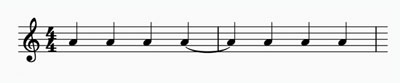
A tie is a line connecting two of the same note, often across a bar line.
But Aren’t These Slurs?
Don’t get these confused with slurs. Slurs are hammer-ons and pull-offs. They may look the same on paper, but slurs (or ligados) are played differently.
- A tie is always between two identical notes
- A slur is always between two different notes
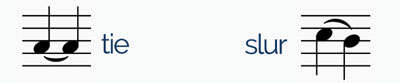
Ties connect two of the same pitch. Slurs connect two different pitches.
What Does a Tie Do in Music?
The curved line connects the two notes and turns them into a single long note. This long note is then equal in length to the two joined notes.
This means that you play the first, but don’t play the second. You just let it ring on for the correct length of the note.
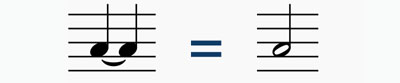
Two quarters tied together equals two beats, which is the same as a half note.
Why Doesn’t the Composer Just Add the Two Notes Together?
The composer can’t add the two notes together to make one long note, because of the bar line. There would be too many beats in the bar.
How to Play Tied Notes
Clap it first
The easiest way to work out how to play a tie is to first clap the rhythm. We count each beat aloud, but only clap on the notes we actually play.
When we reach the ones that are tied together, we count them both out loud but don’t clap the second note (the ‘tied’ note).

Continue counting through the tie. You can say the held beat quietly to show it is tied.
Make the Tie Sound Joined
We can even change the way we count the tied note out loud. We can make our voices ‘join’ the tied beat to its neighbor.
‘One, two, three, fourrrr-one, two three, four.’
Write the Beats Over the Staff in Your Sheet Music
At first, it may be helpful to write the beat numbers over the staff. You can put brackets around the second (tied) beat if it makes it clear that it’s counted, but not played.
Ties in Musical Phrasing
As we advance, we can use ties to play with more expression. The way we place the first note of the tied pair can tell the listener that the note will last longer. Here’s a more advanced lesson on playing ties musically.

Hi, I’m Allen Mathews.
I started as a folk guitarist, then fell in love with classical guitar in my 20’s. Despite a lot of practice and schooling, I still couldn’t get my music to flow well. I struggled with excess tension. My music sounded forced. And my hands and body were often sore. I got frustrated, and couldn’t see the way forward. Then, over the next decade, I studied with two other stellar teachers – one focused on the technical movements, and one on the musical (he was a concert pianist). In time, I came to discover a new set of formulas and movements. These brought new life and vitality to my practice. Now I help guitarists find more comfort and flow in their music, so they play more beautifully.
Click here for a sample formula.
Allen, your website and teaching methods are excellent. You have an easy going yet encouraging way of inspiring people to learn and practice their art. And you are always accessible to your students to personally answer questions. I appreciate ... that personal touch. The course on reading rhythm and playing higher up the neck I found particularly helpful. God bless you and many thanks.
~ Joe Bazan
-Joe Bazan
I just started level 1C...I was able to look at a Carulli piece, albeit a simple one, and understand it. And that understanding allowed me to play it much more easily on the first run through, and I expect it will allow me to make it fully musical at tempo quite soon. That's a huge personal victory for me. Until very recently my mindset was: "Notes on a page. Jimi didn't need them and I don't either." But I ain't Jimi, and now I want those notes on a page.My work in CGS, even at these early levels, got me to that personal breakthrough. And that's given me more confidence that continued work will get me to greater places in due time. So to answer your question: yes, I absolutely feel like I'm making headway and moving forward in my playing. Thank you for that.~ Matthew Ecker
-
“Success lies in relentless execution of the basics.”
Join the program that takes you from the beginning fundamentals to advanced mastery, so you…
- Move your hands safely and fluidly
- Enjoy fulfilling practices and meaningful work
- Play beautifully with expression and flow
Click the button to take a step towards an
organized, effective guitar practice. >>>