Types of Rest in Music: Complete Guide and Common Mistakes
Music is made of sound. But it’s also made by silence.
And the way we use silence in music makes a big difference in how the music communicates. If we play the “spaces between the notes” well, we can create beautiful contrasts. But if we play rests sloppily or carelessly, the playing can sound messy.
So the way we use silence matters. Luckily, composers have specific music symbols to show silence.
These silence symbols are called rests in music notation.
Table of contents
- The Rest in Music Notation
- How Many Beats is a Whole Rest?
- How Many Beats is a Half Rest?
- How Many Beats is a Quarter Rest?
- How Many Beats is an Eighth Rest?
- How Many Beats is a Sixteenth Rest?
- 32nd Rests and Beyond
- Dotted Rests in Music Theory
- How to Count Rests in Music
- The Most Common Mistakes People Make with Music Rests
Free Ebook: Learn Any Piece in 7 Easy Steps
The Rest in Music Notation
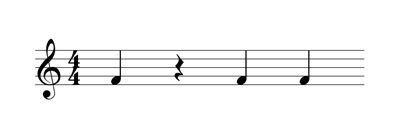
For each music note value, we have a corresponding music rest symbol.
As an example, we have a quarter note. We also have a quarter rest, which gets the same length of time as the quarter note. So if you already know your note values, you’re well on your way.
How Many Beats is a Whole Rest?
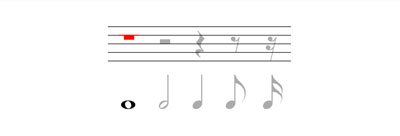 Most often, a whole rest gets four beats, just like the whole note.
The whole rest hangs below the line. We can remember this by thinking that it is so heavy, with a full four beats, that it hangs below.
If a bar is worth four beats, then the whole rest takes up four beats (ie. the whole bar).
However, if the time signature indicates a bar is worth three beats or two beats, then the whole rest no longer gets four beats. It represents the complete bar, no matter how many beats there are in that bar.
Let’s explain:
4/4 time signature: a whole rest = 4 beats (one full measure)
3/4 time signature: a whole rest = 3 beats (one full measure)
2/4 time signature: a whole rest = 2 beats (one full measure)
So, to answer the question, “How many beats is a whole rest?” we need to know how many beats are in our bar.
A whole rest will be worth that number. (ie. The number of beats in a complete bar.)
How Many Beats is a Half Rest?
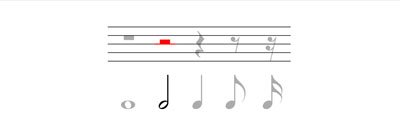
The half rest gets two beats, in the same way as the half note gets two beats. It looks similar to the whole rest, but it sits on top of the line. (We can remember it by thinking “two ‘t’s in ‘sitting’, two beats in a ‘sitting’ rest.”)
How Many Beats is a Quarter Rest?
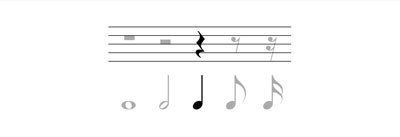
A quarter rest in music gets one beat. This is the counterpart to the quarter note, as mentioned above.
The symbol for the quarter rest is a squiggle.
How Many Beats is an Eighth Rest?
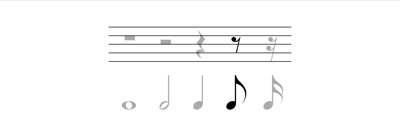
The eighth rest gets half of one beat, just like an eighth note. The eighth rest symbol used here is a slanted stem with a bulbous head, resembling the number 7.
How Many Beats is a Sixteenth Rest?
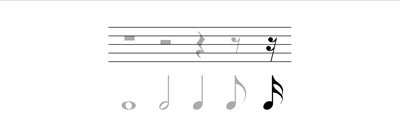
The sixteenth note rest looks like the eighth rest, except we add a flag. This is similar to the way flags work on regular note values.
32nd Rests and Beyond
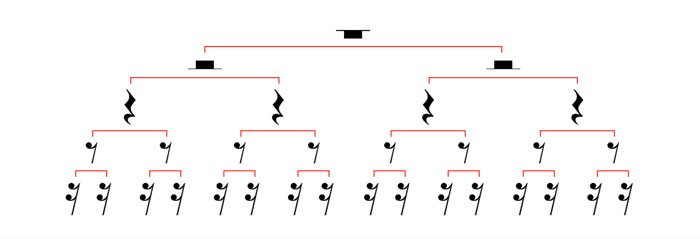
As we progress to 32nd rests, 64th rests, and beyond, we add flags. This is the same routine we use with the note values.
Practice Tips to Learn Music Fast
Dotted Rests in Music Theory
We can also use other symbols to denote rhythm with rests.
For example, we can use dotted rhythms, just like we do with note values. The dots act the same in that they add half the value of the rest to the duration.
We can also use fermatas to suggest a longer duration than normal.
How to Count Rests in Music
When we count and clap rhythms aloud, we can still say the beat numbers as we would with regular notes and rhythms.
For the rests, we would not clap. In fact, some people like to “reverse clap,” meaning they move their hands apart for the rest.
With practice, rests can be an integral part of your clapping and counting rhythms.
The Most Common Mistakes People Make with Music Rests
The most common mistake people make when playing a rest in music is to shortchange it. To not give it the full value of time.
If the rest is meant to last for two full beats, it is a mistake to play the next note before this length of time has passed.
The reason people make this mistake is often that they stop counting during the rests.
So instead of playing the next note at a specific time based on the rhythm, they guess. And when we guess in pieces of music, we usually get it wrong.
The solution is to practice counting through the rests. Just because they are called “rests” do not mean we can relax and stop counting. Quite the opposite – rests are a call to stay alert and place the next note with certainty and precision.
Rests in music are expressive. They are musical, and the more respect and attention we give them, the better we sound.
An Effective Practice Method for You
Many thanks to MusicTheory.net for some of the images above.
Hi, I’m Allen Mathews.
I started as a folk guitarist, then fell in love with classical guitar in my 20’s. Despite a lot of practice and schooling, I still couldn’t get my music to flow well. I struggled with excess tension. My music sounded forced. And my hands and body were often sore. I got frustrated, and couldn’t see the way forward. Then, over the next decade, I studied with two other stellar teachers – one focused on the technical movements, and one on the musical (he was a concert pianist). In time, I came to discover a new set of formulas and movements. These brought new life and vitality to my practice. Now I help guitarists find more comfort and flow in their music, so they play more beautifully.
Click here for a sample formula.
Great Work!!! I thank you sincerely for all the effort you have put in and the terrific work you do for the classical guitar community.
-
Since a year ago with my subscription to CGS it has been for me a pleasurable adventure and a discovery of all the facets of the classical guitar.
Your dedication and enthusiasm, as well as your talent, in the tuition is quite contagious (well, lets hope also for your talent) and has made it fun and useful in my progression. Also the weekly tip that you mail us and the Facebook group is excellent.
~ Michel Donnet
-Michel Donnet
“Success lies in relentless execution of the basics.”
Join the program that takes you from the beginning fundamentals to advanced mastery, so you…
- Move your hands safely and fluidly
- Enjoy fulfilling practices and meaningful work
- Play beautifully with expression and flow
Click the button to take a step towards an
organized, effective guitar practice. >>>