Note Duration – Different Types of Music Notes (Music Theory Lesson)
How can we understand note duration?
In this guide, you’ll learn the different types of music notes, what they look like, how long they last, and how they work together in written music.
Pitch and Rhythm
Music notation has two main parts. These are pitch and rhythm. They are two of the four important elements of music.
Pitch is how high or low the sound of a single note is. This is shown by its position on the musical staff (the five lines).
If we play a series or line of musical notes one after the other, we produce a rhythm. This is constructed from different types of musical notes of various lengths. In music theory, a musical note’s length is known as its note duration or value.
Note values tell us how long to hold each note for. It also shows us how different types of musical notes relate to each other in time. One music note length works together with other note lengths to produce a line of sound called a rhythm. Different combinations of note lengths produce different rhythms.
(Pieces of music also have time signatures. Time signatures are found at the beginning of a line of music. They also help us to understand the rhythm, but we don’t need to worry about these for the moment.)
In this article, you’ll learn all about the music theory concepts of note values, and see what they look like on the musical lines.
Different Types of Notes: Note Duration from Big to Small
In written music (aka “Western notation”), we find a variety of types of musical notes. Each note type has a different note value. When reading along a line of music, we can tell one note from another based on its note head, stem (vertical lines), and beams (horizontal lines).
We can think of note values as a pizza. We can cut it in half, then in half again. If we want, we can keep cutting each slice in half to make smaller and smaller pieces. And each slice has a direct proportion to the others. It’s the same with notes.
Let’s start with the whole pie.
Whole Notes
The whole note gets four beats. Sometimes called a semibreve, the whole note looks like a circle. In standard music notation, this will be a black circle with a white center (aka the “note head”). We can say that the center is empty. It can be placed ‘on’ the staff line (so the line crosses through its middle) or between two lines (so in a ‘space’).
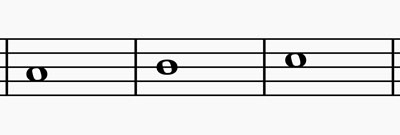
Whole notes in music notation. Whole notes get 4 beats.
When we count this, we say 1,2,3,4. When we play it, we hold the note for 4 full beats at the chosen speed (tempo). We call this a four-beat note.
Clapping and counting the music is useful in studying rhythm and learning a piece of music. And for the moment, we don’t need to worry about the note names. (These are allocated depending on which lines of the staff the note is ‘on’ or between.)
Half Notes
A half note gets two beats. Sometimes called a minim, its duration is half the time of a whole note (like cutting the pizza in half). Two half notes (two beats) last as long as one whole note (four beats).
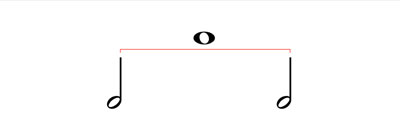
Half notes get 2 beats.
When counting a half note, we say 1, 2. And we hold this note for the full two beats. We call it a two-beat note.
Visually, we add a stem to the circle. The stem can either point up or down. Notes higher on the staff usually point the stem down, and vice versa. The stem direction keeps the music tidier on the page. Sometimes you’ll see the same note appear multiple times with different stem directions. But both stem directions are correct.
Occasionally, we see a half note with a dot after it. (A dotted half note.) A dot extends the duration of any note by half of its value again. So here, a two-beat half note would become a three-beat dotted half note.
Quarter Notes
The quarter note (crotchet) gets one beat (one-beat note), or half of a half note. And four quarter notes add up to the same duration as one whole note.
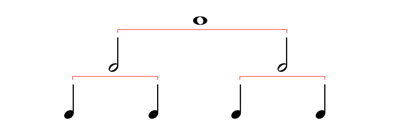
Quarter notes get 1 beat.
We count these 1, 1, 1, 1. Or we can count them by their placement in a measure of music: 1, 2, 3, 4. We hold each quarter note for one beat only.
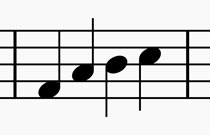
The stems of notes can go up or down. This does not affect the duration. Stem direction may be chosen to organize the music on the page or to denote different musical parts. (Eg. melody and accompaniment.)
We can recognize a quarter note as a black (filled) note head with a stem. The direction of the stem does not change the value of the note.
Occasionally, we see a quarter note with a dot after it. (A dotted quarter note.) As with the dotted half note, the dot extends the duration of the note by half of its value again. (So one beat becomes one and a half beats.)
Eighth Notes
The eighth note gets 1/2 of a beat. Sometimes called a quaver, the eighth note is half of a quarter note. Two eighth notes equal the duration of one quarter note (one beat).
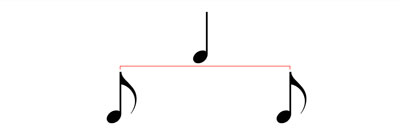
Eighth notes get half of one beat. Two 8ths equal the duration of a quarter note.
As there are two eighth notes in one beat (quarter note), we count a beat of eighth notes “1-and.” The eighth note on a main beat gets the number of that beat, and the next gets “and.”
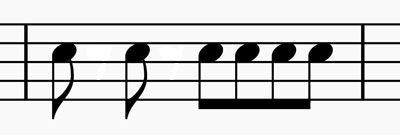
Single 8th notes have a flag. Multiple 8th notes may have connected flags (beam).
To notate eighths, we add a flag to the stem of a quarter note. And when we have more than one, we can often join the flags together (beams). They become beamed notes. They each still last the same duration as a flagged note, even though they look like different types of musical notes. There are various musical rules about beaming, but we most often see beams across two or four eighth notes.
Sixteenth Notes
The sixteenth note gets quarter of a beat. Keeping in the same pattern as the notes above, we again slice the previous note in half. One quarter note (one beat) sliced in two makes two eighth notes. Two eighth notes (half beats) split in half produce four sixteenth. So eight sixteenths equal the duration of a half note (two beats). And 16 sixteenths make a whole note (four beats). Basic fractions.
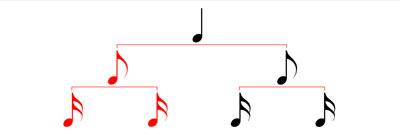
16th notes get 1/4 of a beat. Four 16ths equal the duration of a quarter note.
Sixteenths get two flags. And we count a beat of sixteenths as 1-e-&-a. “One-eee-and-ahh.” This keeps them in groups of a beat. We can then count “One-eee-and-ahh”, “two-eee-and-ahh”, “three-eee-and-ahh”, etc.
32nds, 64ths, and beyond
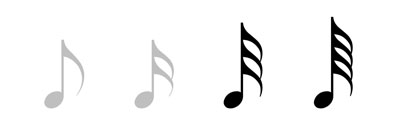
For 32nds, 64ths, and beyond, we continue to add flags to the note stem.
We can continue to divide each note value in half to create 32nds, 64ths, 128ths, 256ths, and beyond to infinity. For each note value, we add another flag. But we rarely see anything past a 64th (which is rare in itself). Usually, it would be easier to just double the written tempo (speed) of the music and write it using 8ths or 16ths. All these can be written as beamed notes like the eighths notes above.
Many thanks to MusicTheory.net for some of the images above.
FAQs
Q: What are the basic types of music notes?
A: The most common music notes include whole, half, quarter, eighth, and sixteenth notes. Each has a different duration and symbol in standard music notation.
Q: What is the difference between a whole note and a half note?
A: A whole note lasts four beats in 4/4 time, while a half note lasts two beats. The symbol also changes from an empty note head to one with a stem.

Hi, I’m Allen Mathews.
I started as a folk guitarist, then fell in love with classical guitar in my 20’s. Despite a lot of practice and schooling, I still couldn’t get my music to flow well. I struggled with excess tension. My music sounded forced. And my hands and body were often sore. I got frustrated, and couldn’t see the way forward. Then, over the next decade, I studied with two other stellar teachers – one focused on the technical movements, and one on the musical (he was a concert pianist). In time, I came to discover a new set of formulas and movements. These brought new life and vitality to my practice. Now I help guitarists find more comfort and flow in their music, so they play more beautifully.
Click here for a sample formula.
Your GCS site and The Woodshed community are really super! I am glad I finally joined in, and smacking myself for waiting so long. Thanks again!
~ Carol Morin
-Carol Morin
Allen Mathews was recommended to me as somebody who could help me expand my guitar vocabulary. Allen started me on a really fun cycle of lessons and practice. He is a very good,and very enthusiastic teacher, and I feel that I'm on the road to learning. I couldn't be more pleased with my experience.
~ Peter Buck (r.e.m.)
-Peter Buck (r.e.m.)
“Success lies in relentless execution of the basics.”
Join the program that takes you from the beginning fundamentals to advanced mastery, so you…
- Move your hands safely and fluidly
- Enjoy fulfilling practices and meaningful work
- Play beautifully with expression and flow
Click the button to take a step towards an
organized, effective guitar practice. >>>