Comfortable Barre Chords – How to Make Bar Chords
Barre chords are strenuous. They take finger strength and endurance. They are hard to get right and easy to get wrong.
But there are ways to make them more likely to work. If we use our bodies well, a barre chord can be, if not comfortable, at least doable.
Our normal, open-position, “cowboy chords” use each finger just once. But for the barre, we need strategy and strength.
How to Play Barre Chords on Guitar
The bar, or barre, is a guitar technique whereby guitar players hold down multiple strings with one finger.
We usually bar with the first (index) finger. Depending on the music, we may hold down all six strings, or as little as two.
Start With the Right Position on the Fret
To begin, place your index finger on top of a fret (not behind the fret as usual).
Then, keeping pressure, push or roll your index finger back to behind the fret.
This action tightens the skin on the index finger and makes the surface harder (or at least less pillowy). This harder finger surface will hold down the strings with less effort.
Avoid the Death Grip
When we first learn barre chords, we’re tempted to squeeze as hard as is necessary to sound all the strings. This can work, but it takes a lot of energy, and can hurt.
The “death grip” also happens when we apply pressure to the index finger with the middle finger. Reinforcing the index finger with the middle finger increases pressure and over-squeezing of the hand.
Instead of “lobster clawing” every barre chord, we can use the weight of our arm to partially press the strings. This reduces the overall effort needed.
“Turn the Knob”
We can also use a forearm twist to help play a barre chord. This is the motion of turning the palm downwards as we twist the left arm. On the guitar neck, this creates a torquing motion that can help press the strings.
Know Which Strings Need to Sound
Often in classical guitar pieces, we don’t play every note within a bar chord. We may need just two or three notes.
When this is the case, we can notice which strings need to sound. Then, we can adjust the pressure of the bar to sound those strings, even if other strings would buzz if played. We do this by pressing with the tip joint, pressing the middle joint in, or pressing at the base of the finger.
Over time, we can become more sensitive to the different areas in a barre chord and can use selective pressure to reduce work. We can keep some strings actively pressed while ignoring others.
Consider Adjusting the Action and String Tension
Another factor that may cause unneeded tension in the left hand could be the guitar action. This is the distance between the strings and the fretboard.
We can adjust the action on an acoustic guitar easily if it has a truss rod. Most classical guitars need adjusting by a qualified luthier or guitar tech.
We can also consider the effect of our string gauge. Experimenting with lower-tension strings can often help. Lower string tension can let us relax more when playing.
These solutions should be last-ditch efforts. Usually, the solution lies in our playing or technique. As the saying goes: a poor workman blames his tools.
Learn the Basic Barre Chord Shapes
Start by playing an E chord in first position with your middle finger, ring finger, and pinky finger.
Now shift this e shape up by one fret. Place your first finger in a bar along the first fret, from the low E string to the high E string (aka creating a “full barre”).
You’ve created your first bar chord: the F barre chord!
This is your major bar chord shape. By lifting the middle finger off of the G string (third string), you’ll turn this major shape into a minor shape.
Once you learn the basic shapes, you’ll be able to play bar chords up and down the guitar’s neck. Unlike an open chord, you can move the barre shape up and down the neck to create different chords.
Check Out the Full Course on Bar Chords
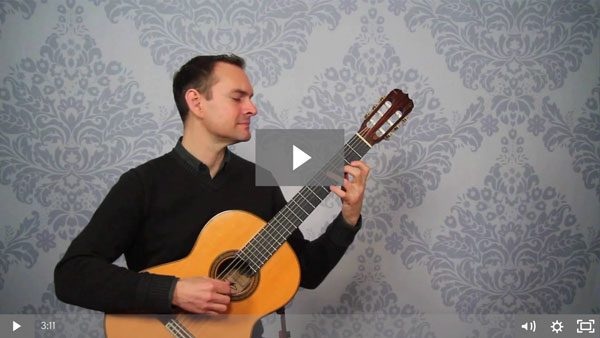
This video was taken from the CGS course, All About Bar Chords. In it, we discuss the “how” of barre chords, as well as the why. We explore the main chord “shapes” that use a barre chord. And we identify and practice barre chords up and down the entire instrument.

Hi, I’m Allen Mathews.
I started as a folk guitarist, then fell in love with classical guitar in my 20’s. Despite a lot of practice and schooling, I still couldn’t get my music to flow well. I struggled with excess tension. My music sounded forced. And my hands and body were often sore. I got frustrated, and couldn’t see the way forward. Then, over the next decade, I studied with two other stellar teachers – one focused on the technical movements, and one on the musical (he was a concert pianist). In time, I came to discover a new set of formulas and movements. These brought new life and vitality to my practice. Now I help guitarists find more comfort and flow in their music, so they play more beautifully.
Click here for a sample formula.
Life is good, still enjoying [The Woodshed Program], the progress is life altering, I love it. The physical challenges of my situation have rained havoc for over half my life. In spite of those little pests this 40$ Yamaha classical who needed a new home and your course has given me the "part the clouds for the sun to shine through" outlook. You see, even when I am unable to play I know she patiently waits for my return as I do. A giant void in my journey was filled with light.
~ Ken Montz
-Ken Montz
Hi Allen,
Greetings from the UK. I would like to thank you for providing such an excellent resource. The effort and skill which has gone into creating this program is very evident. I started classical guitar a year or so ago with a teacher but was unable to commit to same time regular slots each week.The Woodshed Program was exactly what I was looking for. I have found the site very intuitive and well structured and have taken your advice and started from the very beginning of the program whilst still practising some of the pieces I was already working on. It is clear that I will benefit greatly from these early technical studies. There were clearly weaknesses and gaps in my knowledge even though I am still at an early stage. Once again many thanks for the program and very best wishes.
~ Rodger Paylor
-Rodger Paylor
“Success lies in relentless execution of the basics.”
Join the program that takes you from the beginning fundamentals to advanced mastery, so you…
- Move your hands safely and fluidly
- Enjoy fulfilling practices and meaningful work
- Play beautifully with expression and flow
Click the button to take a step towards an
organized, effective guitar practice. >>>