How Barre Chords Were Born on Guitar: The Bar Chord Formula
Barre chords (also known as bar chords) are some of the most useful chords we can learn on the guitar.
We can use them to play all over the fretboard.
We can read them off a lead sheet or chord charts to play with a singer or join in a jam session.
And bar chords are frequently found notated in classical guitar sheet music. We recognize them by the letter B (or C for ‘capo’ or ‘cejilla’) along with a bracket and fret position.
But where did guitar barre chords come from, and what is the logic behind them?
What is a Barre Chord?
The name ‘barre’ comes from the French. It means a bar.
In a barre chord, the first finger presses down behind the fret on more than one string. It can cover all six strings if necessary. We can place it on any fret, so it’s helpful to think of the finger (bar) acting as a moveable nut up and down the guitar neck. It’s a bit like using a capo.
As a reminder, the nut of the guitar is “fret zero,” near the tuning keys. It stops the strings at that point.
Occasionally, we can use other fingers as a barre. In electric and acoustic guitar playing, it’s quite common to use the third finger as a barre finger. And some classical guitarists even use their fourth. But the easiest finger to place cleanly behind the frets is the first finger.
What is an Open Chord?
An open chord is one which uses one or more open strings, with no finger pressing that string on any fret.
They’re sometimes called ‘Cowboy Chords’, and they crop up all the time. Many of us are familiar with chords like Am, E, D, G, and C. They are amongst the first chords we learn to fret when we’re strumming a song.
These chords are a foundational element of playing guitar in any style. They are very popular with beginner guitarists, in particular.
How To Make Barre Chords Out of Open Chords
You can make a barre chord out of any open chord you might know. You do this by changing the left-hand fingering. We then use the index finger on any fret to replace the open string.
How to Name a Barre Chord
The chord name changes when we move the barre chord up and down frets along the neck. The name of the chord will be the same as the name of the note under the first finger on the sixth string. This is the ‘root’ of the chord.
The root (chord name) is marked in red in the images below.
So if we put the barred finger of an E chord over fret one, the root will be F. The chord will become an F major chord. Move the shape up to the second fret, and it will become F#.
How to Make an E Shape Barre Chord
For instance, take the open E major chord illustrated here.
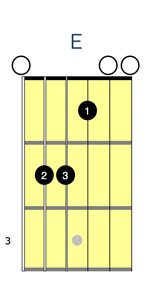
We usually use fingers 2, 3, and 1 for the E chord. That’s three open strings and three fretted strings.
So what happens if we switch our fingers around?
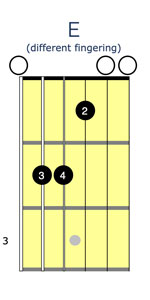
If we use fingers 2, 3, and 4 on the same frets, we make the index finger available to become the bar.
If we then place our index finger over the nut, as if we are replacing it, we have the basis of a barre chord.
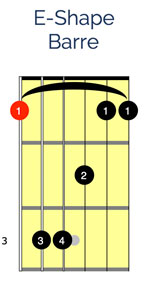
If we keep this shape over the strings, we can then move this chord to any fret anywhere on the neck. We just need to keep the shape constant.
How to Use a D Chord Shape for Barres
To convert the open D chord into a barre chord shape, we do the same thing.
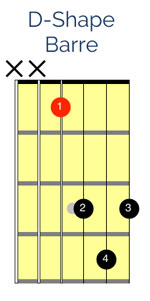
We switch over fingers 1, 2, and 3, and instead use 2, 3, and 4. It’s a bit of a stretch, but we then hover our first finger over the nut.
Once we’ve got that shape secure, we can move it around the guitar neck in the same way as the E chord shape.
(The image shows it barred on the first fret. But because we are fretting strings 3, 2 and 1, we don’t need to extend the bar across those strings.)
Note that the root of a D shape barre chord is always on the fourth (D) string.
How to Use a G Chord Shape
Four-finger chords can also become barre shapes. But if we’re using four fingers, we need to get rid of one of them to free up the index finger.
An open G chord can be played with four fingers. See the first image below. We can remove the third finger and play the open B string.
We then position our index finger over the nut, and we’ll have the correct shape to move our guitar barre chords around the fretboard. We adjust the other fingers as shown.
It’s a big stretch to play the full G chord as a moveable barre chord. So we can split this shape into two different shapes – one low and one high. These shapes are very common to see in pieces of music.
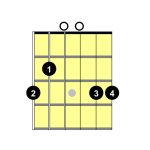
The G Major Chord using fingers 1, 2, 3, and 4
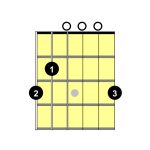
G Major Chord
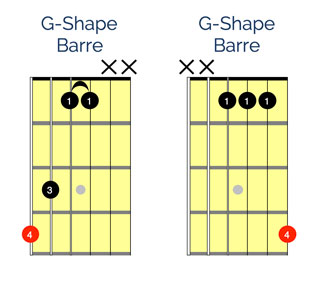
What if I Can’t Stretch that Far?
Playing barre chords well can take patience. It takes time to build finger strength. And there is a learning process we need to go through before they become easier to play.
Finger and hand strength play a part. But simply adding more pressure with the small muscles is not the best way to go. It’s all about technique. We do have methods to make barre chords easier to play. But sometimes the stretch is still pretty tricky.
So, what happens if we can’t stretch our fingers that far yet?
Well, these awkward stretch chord shapes (like the G chord) aren’t found in music very much. But we do find fragments of that shape. These fragmented shapes crop up all the time in classical guitar notation.
This means we can use variations rather than the whole barre chord. We don’t need to use so much pressure, and it sounds better. It also saves frustration.
Sometimes we use only the top four strings of the G shape to move around the neck. Sometimes we move our fingers only on the bass strings in the same way. They’re still part of that G shape. The barre chord technique doesn’t have to cover all the strings.
We can fingerpick the strings we need, rather than using a strum. This way, it can be a bit easier to mute strings we don’t want.
Is it the Same for Minor Chords?
The formula we use for a major barre chord is exactly the same for the minor chords.
If you know your minor open chord shapes, like Dm, Am, and Em, you’ll be able to turn them into barre chords and move them to a different fret.
It’s the same for 7th chords.
Pick a Chord: Any Chord
The beauty of barre chords is their flexibility. We simply take the open chord and convert it by barring with our first finger.
And if we know the names of the notes on the bass strings, we’ll be able to find and play barre chords in any major or minor key. This is invaluable when we’re playing music with other musicians. It means we can use the same shape for different chords no matter which key we’re in.
For more hints and tips on how to play barre chords, check out the full course.

Hi, I’m Allen Mathews.
I started as a folk guitarist, then fell in love with classical guitar in my 20’s. Despite a lot of practice and schooling, I still couldn’t get my music to flow well. I struggled with excess tension. My music sounded forced. And my hands and body were often sore. I got frustrated, and couldn’t see the way forward. Then, over the next decade, I studied with two other stellar teachers – one focused on the technical movements, and one on the musical (he was a concert pianist). In time, I came to discover a new set of formulas and movements. These brought new life and vitality to my practice. Now I help guitarists find more comfort and flow in their music, so they play more beautifully.
Click here for a sample formula.
I just started level 1C...I was able to look at a Carulli piece, albeit a simple one, and understand it. And that understanding allowed me to play it much more easily on the first run through, and I expect it will allow me to make it fully musical at tempo quite soon. That's a huge personal victory for me. Until very recently my mindset was: "Notes on a page. Jimi didn't need them and I don't either." But I ain't Jimi, and now I want those notes on a page.My work in CGS, even at these early levels, got me to that personal breakthrough. And that's given me more confidence that continued work will get me to greater places in due time. So to answer your question: yes, I absolutely feel like I'm making headway and moving forward in my playing. Thank you for that.~ Matthew Ecker
-
Hi allen, it amazes me how good and precise your teachings are. The best thing I ever did was to download a piece of music from you and to listen to your videos. The enjoyment I now have from playing is ten fold. Thanks!
Regards,
~ Tony Christopher
-Tony Christopher
“Success lies in relentless execution of the basics.”
Join the program that takes you from the beginning fundamentals to advanced mastery, so you…
- Move your hands safely and fluidly
- Enjoy fulfilling practices and meaningful work
- Play beautifully with expression and flow
Click the button to take a step towards an
organized, effective guitar practice. >>>