How to Play Half-Barres on Guitar
Barre chords (or bar chords) are a challenge at first for most guitarists. And half-barres or partial barres are no different.
Half-barres have their own unique needs and requirements. But played well they can be easeful and clear, fluid and sonorous.
What is a Barre Chord?
We can play more than one string with the same finger at the same time. When we do, we “barre” our finger across the strings. This is a barre chord.
Often, we bar 5 or 6 strings, which is a full barre. When we barre fewer than this, we have a partial, or half-barre.
A 5-string barre is technically a partial barre, but the technique used is that of a full barre. When we barre fewer, we may need to use the hand in different ways.
How Half-Barres are Notated in Sheet Music
Barre chords are often notated with a “C” (for capo) and a Roman Numeral denoting the fret number. So a barre on the 7th fret would be notated: CVII.
As a reminder, I=1, V=5, and X=10. A common anagram for Roman Numerals is “I Value Xylophones Like Cows Dig Milk.” 1, 5, 10, 50, 100, 500, 1000.
Half-barres use this same formula as full barres but are often preceded by a fraction. This fraction shows how many strings are to be played.
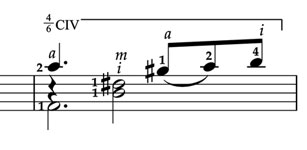
Half-barre notation: fraction, C (for “capo”), then Roman Numeral
For example, 4/6CIV would tell us to bar four of the six strings on the fourth fret. We may also see 2/3CIV, which means the same.
This is not consistent across composers and editors. But it should always make sense. We may see 2/6 or 1/3. Either way, we can figure out what to do.
A bracket stemming from the notation will tell us how long to hold the barre and when to release it.
Helpful Hints for Half-Barre Chords
To place the barre, we can use the same general first-finger technique as in full barres. Instead of pressing the index finger flat on the string, we can roll it back. This tightens the skin and makes it “harder.”
When we play to the side of the finger, we can use leverage to press the finger into the guitar.
If we are only squeezing with the thumb, we will overwork and fatigue. Instead, we can use a torquing or twisting movement to add pressure and hold down the strings.
We can also keep our hand aligned with our forearm, and space in the hand. This gives us a mechanical advantage and easier use of the other fingers.
How to self-check your half-barre
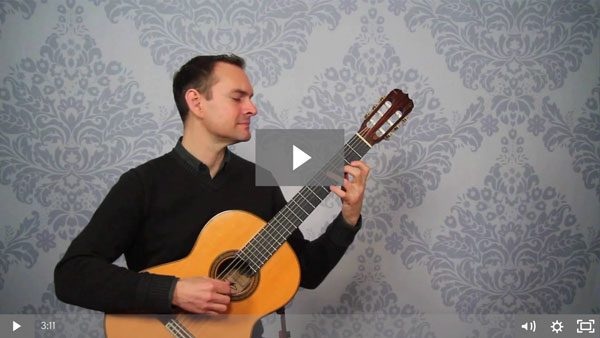
If you play in front of the mirror, or you video yourself, you can look for good form.
If you can see your palm, you are allowing your wrist to collapse and are over-rotating. Your other fingers should be over the strings and able to access the frets for all the strings barred.
Also, look for a straight and gently curved line from your index finger to your elbow. If there are any extreme angles, something is amiss.
Most People Struggle at First – Keep With It
It is the rare bird that aces barre chords on the first day. Most people feel awkward and hear buzzes and muted strings. This is completely normal.
With practice, barre chords do come together. They get easier and less strenuous. They always take effort, especially for prolonged or frequent barres. But time does tend to tame them.
If you find your barres or half-barres buzzing, be patient. Assess which string is buzzing. Play with the distribution of tension across your first finger. And rest assured that in time it will come together.
Good luck!

Hi, I’m Allen Mathews.
I started as a folk guitarist, then fell in love with classical guitar in my 20’s. Despite a lot of practice and schooling, I still couldn’t get my music to flow well. I struggled with excess tension. My music sounded forced. And my hands and body were often sore. I got frustrated, and couldn’t see the way forward. Then, over the next decade, I studied with two other stellar teachers – one focused on the technical movements, and one on the musical (he was a concert pianist). In time, I came to discover a new set of formulas and movements. These brought new life and vitality to my practice. Now I help guitarists find more comfort and flow in their music, so they play more beautifully.
Click here for a sample formula.
I also want to thank you for including more video lessons on the Bridges Guitar Series. I have learned to play Calatayud's Waltz. The most exciting thing about having done this is that I sight-read the entire piece as I was learning it. Six months ago looking at a sheet of music was like looking at Egyptian hieroglyphics. Learning to read notation is empowering and I appreciate the sensible way you are teaching us to learn to read music.
~ Steve Simpler
-Steve Simpler
After more than a year as a member, I remain impressed with the Woodshed, song courses, Tuesday quotes, weekly lessons, and the CGS community. Without my membership, I think my enthusiasm for learning classical guitar would have faded long ago. Instead, I am enjoying the process as I make steady progress in my playing.
~ Steve Dosh
-Steve Dosh
“Success lies in relentless execution of the basics.”
Join the program that takes you from the beginning fundamentals to advanced mastery, so you…
- Move your hands safely and fluidly
- Enjoy fulfilling practices and meaningful work
- Play beautifully with expression and flow
Click the button to take a step towards an
organized, effective guitar practice. >>>