All About Accidentals In Music Notation
What are accidentals in music?
Sometimes when we play a piece from sheet music, we come across a little musical symbol in front of a single note. It will always be to the left-hand side of the note-head, and might look like this:
- # (or ##)
- b (or bb)
- ♮
This is called an accidental sign. We usually just call them “accidepitntals”.
Individually, they are called:
- # = Sharp accidental
- b = Flat accidental
- = Natural accidental
You may already have come across some of these signs in a key signature. Key signatures instruct us to apply two of these signs (sharps and flats) throughout the whole piece.
But accidentals in music are placed in front of specific notes. They are extra instructions, relevant only to the measure (bar) in which they appear.
An accidental sign raises or lowers the sound of a note. Sharps raise the note, and flats lower the note. A natural sign reverts the note to its original pitch. In effect, it cancels out a previous accidental that may have been applied to the note.
What is an Accidental in Music?
Accidentals are more than just a folk-rock band. In music theory and sheet music, composers use accidentals to instruct us to make a change to the note immediately next to it.
Each accidental also applies to any other identical note in the same measure. So if an accidental is in front of the note B, it changes all the other Bs in the measure too.
How Are Accidentals Written – And What Do They Mean?
Like all elements of music theory, we have standard ways of writing accidentals. And accidentals work the same in melodies or chords.
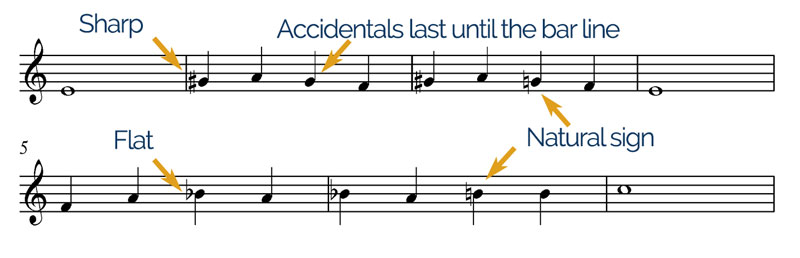
Accidentals are sharps, flats, and naturals that have been added only to a note or bar of music.
Flats
A flat is indicated by a b sign in front of a note.
It means we need to lower the note by a half-step. (There’s more on half – and whole-steps below). Our finger moves down one fret towards the tuning keys of the guitar.
Sharps
A sharp is indicated by a # sign in front of a note.
It means we need to raise the note by a half-step. Our finger moves up a fret towards the body of the guitar.
Double Accidentals
We don’t often come across double accidentals in music. If we do, we just do the job twice. The note is raised or lowered a further half-step.
- A double sharp (##) means we move up two frets instead of one. (A double sharp sign can also look like this: X)
- A double flat (bb) means we move down two frets instead of one
So a double accidental changes the note by a complete whole tone (more on this below). A double sharp applied raises the note, and a double flat flattens it. When we play it, it sounds like the next note up (or down) in the scale. So A ## sounds like the same note as B.
Which is strange, because wouldn’t we then expect it to have an entirely different note name?
Well, yes. But standard rules in music theory prevent us from renaming that note. The use of the original note name keeps the special relationship of notes in a scale correct.
But What If We Want to Cancel the Accidental?
There are two ways to undo an accidental sharp or flat.
The Bar Line
The bar line cancels out any accidentals. Sharps and flats only apply to one measure. So if we want a flattened note to be flat in the next measure as well, we have to use another accidental.
The Natural Sign in Music Notation
A natural sign cancels previous accidentals. It’s indicated by a ? in front of a note. Sometimes, this sign is also called a kite, because it resembles one.
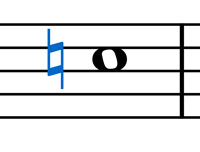
The natural sign (kite) cancels the sharp or flat of a note until the barline.
We use this symbol to cancel an accidental before the end of the bar.
For example, a B flat will revert to normal (B natural) if there is a natural sign in front of it.
Any other identical notes in that measure also then revert to their original status.
And the natural sign is also used to cancel out a flat or sharp in a key signature, and again only lasts for one measure.
Accidentals in Brackets
Sometimes we see an accidental in brackets like this.
(#) (b)
Composers or editors occasionally do this to remind us that there’s been a change since the last bar. It can be a helpful prompt. But as long as we remember that in music theory, sharps, flats and naturals are always all canceled out by the bar line, we shouldn’t need a reminder.
What About Tied Notes?
Where we see tied notes, an accidental sign applies to the second note as well as the first. But the accidental will be shown to the left of the first of the tied notes only.
Pitch, Half-steps, and Whole-steps on the Guitar
To play an accidental, we need to understand the terms ‘pitch’, ‘half-steps’ and ‘whole-steps’.
‘Pitch’ refers to the place each note has in its musical scale. When we play a note, the sound we hear is its pitch.
‘Half-steps’ and ‘whole-steps’ can also be called ‘semi-tones’ and ‘tones’ (in the UK, for example). They form the building blocks for all scales found in Western music.
Pianos and guitars are instruments where moving a half-step up or down in pitch is visually logical. On the piano, we move our fingers left or right from a white note to a black one. (If there’s no black key, we simply move to the next white one.) The interval between the white notes and the black notes is a half step.
On a guitar, we move up or down the frets.
- Half-step = 1 fret on guitar
- Whole-step = 2 frets on the guitar
Half-Step (semi-tone)
On a guitar, a half-step is the difference in pitch between any two neighboring frets. So if we move our finger from the second fret to the third fret, we’ve moved our finger a half-step.
Whole-step (tone)
A whole-step is the difference in pitch between three neighboring frets. So if we move our finger from the second fret to the fourth fret (skipping fret three), we’ve moved our finger a whole-step.
Guitar Fretboards – Which Way Is Up?
When we move our fingers on the fretboard, we change the pitch of a note either up or down.
Moving ‘up’ from fret 2 to 3 (ie. towards the body of the guitar) makes our note sound a half-step higher. This sharpens the note.
Moving ‘down’ from fret 3 to 2 (ie. towards the head of the guitar) makes our note sound a half-step lower. This flattens the note.
How Accidentals Sound in Music
Accidentals can add musical color and emotion to music. Composers use them to move outside the basic notes of a key.
The main key of a piece of music feels like home. We can expect and anticipate the notes and chords.
But when a composer moves one or more of the notes outside of the expected notes, it adds interest. We may understand more of the emotion of the music. Or we may understand more of the character the composer intends.
Musical ornaments may use accidentals. And we may find accidentals are used to pull us into a new set of home-base notes (i.e. modulating to a different key).
Improvised music, like jazz, often contains many accidentals.
Accidentals are a powerful musical tool to create mood and guide the music forward.

Hi, I’m Allen Mathews.
I started as a folk guitarist, then fell in love with classical guitar in my 20’s. Despite a lot of practice and schooling, I still couldn’t get my music to flow well. I struggled with excess tension. My music sounded forced. And my hands and body were often sore. I got frustrated, and couldn’t see the way forward. Then, over the next decade, I studied with two other stellar teachers – one focused on the technical movements, and one on the musical (he was a concert pianist). In time, I came to discover a new set of formulas and movements. These brought new life and vitality to my practice. Now I help guitarists find more comfort and flow in their music, so they play more beautifully.
Click here for a sample formula.
Hi Allen, I am thoroughly enjoying your website and I find it is just what I need in my renewed passion for classical guitar. I have rediscovered a great love for this instrument and the music I can learn and play and it has changed my life for the better dramatically! Thank you for facilitating this process.~
~ George Rogers
-George Rogers
I have to say, two practices later [after a video review] with the new position - the difference it's made in my playing is... unbelievable, really. It's like many months of improvement overnight.
Everything is so much more secure, left-hand stretches are easier, I feel like I'm getting way more volume for the same effort, the tone is noticeably better all along the neck, and the list goes on.
Thank you!
~ Alexander Mosolov
-
“Success lies in relentless execution of the basics.”
Join the program that takes you from the beginning fundamentals to advanced mastery, so you…
- Move your hands safely and fluidly
- Enjoy fulfilling practices and meaningful work
- Play beautifully with expression and flow
Click the button to take a step towards an
organized, effective guitar practice. >>>