Key Signatures Made Easy: A Quick Way to Find the Key of a Song
What is a key signature in music theory? And how can we quickly find the key of any song?
A key signature tells us a group of notes we’ll play (and which notes we will probably avoid). We may add or subtract notes, but the key of a piece gives us a starting place – a collection of notes that make up “homebase.”
Luckily, there are a couple of tricks that make it easy to find the key signature (“key”) of any piece of music.
Table of contents
Learn Any Piece in 7 Easy Steps: Click to Download
What is A Key Signature in Music?
The key signature is the collection of sharps or flats at the beginning of a line of music.
Each of the 12 musical major keys has a unique combination of sharps or flats. Minor keys share a key signature with a major key, so there are only 12 in total.
Here is a key signature chart showing all the musical keys:
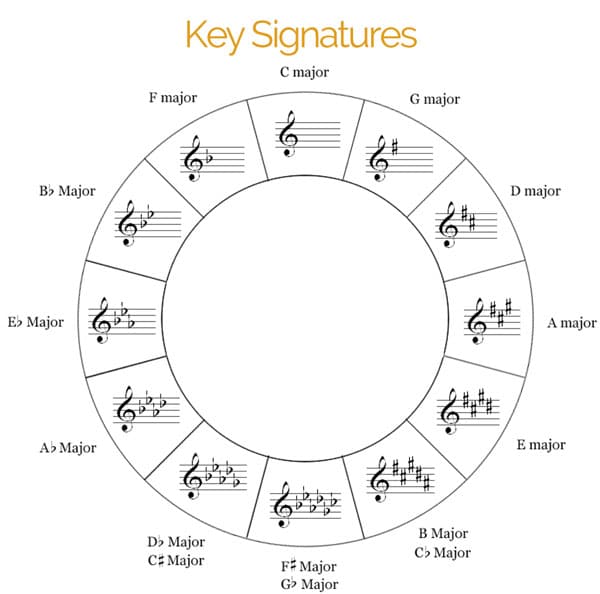
Key Signature Chart
When we see the sharps or flats at the beginning of a line of music, we play those notes sharped or flatten whenever we see them in the music. For example, an F# in the key signature tells us to play every F in the piece as F#.
This way the music is not littered with sharps and flats in every bar.
When we know the notes in the key signature, it can help us sight-read the music more easily.
How to Find the Key Signature of Sharp Keys
When we have sharps (#) in the key signature, they will appear in a certain order.
The order of sharps is FCGDAEB. This means that if a piece has three sharps, those will be FCG. If a piece has four sharps, they will be FCGD. And so on.
ORDER OF SHARPS: F C G D A E B
To find the key of the piece, first name the last sharp—the one furthest right.
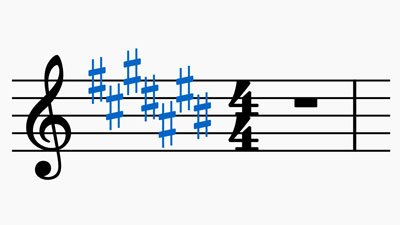
The order of sharps is: F C G D A E B
This last sharp is the leading tone. That means that the root of the key (the name of the key) is one half step above this note. In other words, move up one fret from the last sharp and you have the key.
So the process to find the key of a piece in a sharp key is:
- Name the last sharp (furthest right)
- Move up one half step (or fret)
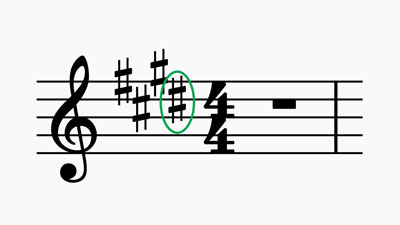
To find the key, move one half-step (fret) up from the last sharp.
Example #1
So if we have one sharp, it will be F#. The note just above this note is G. This means that the piece is in the key of G.
Example #2
As another example, say we have three sharps. The sharps will be FCG. The one on the right is G#. The note just above G# is A. So the key of A has three sharps.
Read the Report: How to Learn Pieces Faster
How to Find the Key Signature of Flat Keys
The order of flats in key signatures is the opposite the sharps. The order of flats is BEADGCF.
This is easy to remember because it contains the word “BEAD.”
ORDER OF FLATS: B E A D G C F
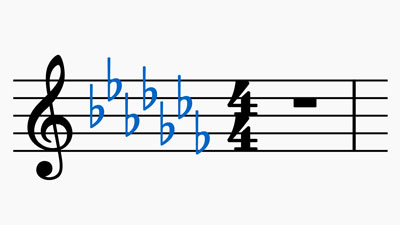
The order of flats in music is B E A D G C F
To quickly find the key signature in flat keys, we find the second flat from the right. This is the key center.
For music with just one flat in the key signature, we have to memorize that this is the key of F. No trick here, just something to memorize.
Again, how to find the key of music in flat keys:
- Name the flat that is second from the right. This is the key.
- If only one flat, it is the key of F
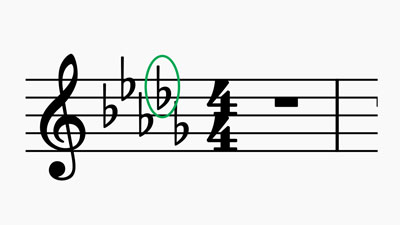
To find the key in flat keys, name the flat second from the right.
Example #1
For example, say we have a key signature with three flats. The three flats will be BEA. The second back from the right is Eb. And indeed, Eb is the key with the three flats.
Example #2
Another example has six flats. Here our flats will be BEADGC. The second back is Gb. And indeed, the key of Gb contains six flats.
Minor Keys (Sharps and Flats)
Minor keys utilize both sharps and flats in their key signatures, just like major keys.
Every major key has a relative minor key, which shares the same key signature. The relative minor key is always a minor third (interval) below its major counterpart.
For example, the relative minor of C major is A minor, and they both share the same key signature of no sharps or flats.
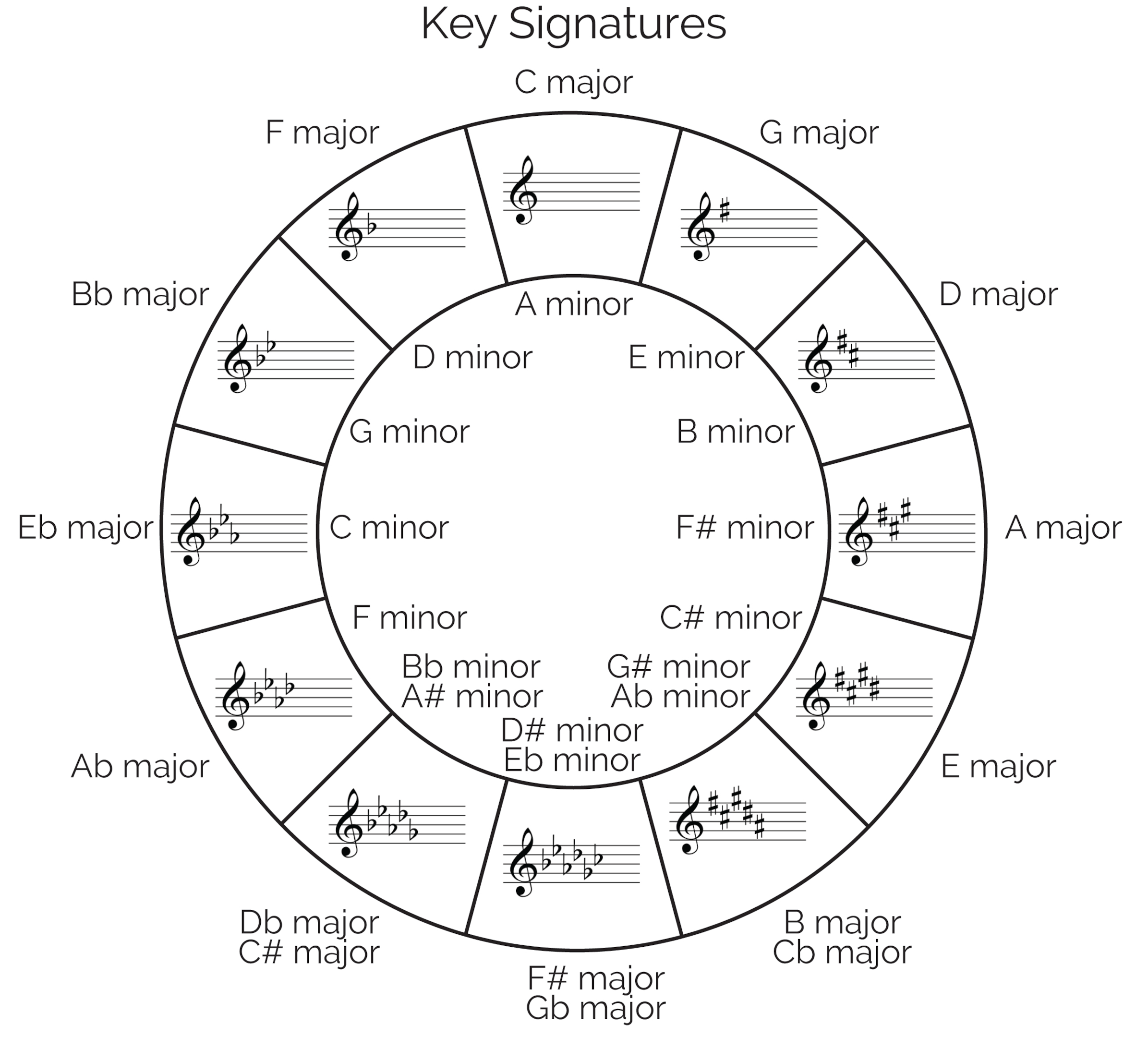
Key Signatures – Major and Minor Keys
The relationship between minor and major keys allows musicians to easily identify the relative minor key of any major key, simplifying the process of understanding and playing in different tonalities.
However, the relationship between the two is slightly different. For example, the key of A minor contains no sharps or flats in its natural form.
The notes in the A Natural Minor scale are:
A B C D E F G A
However, when A minor is played “harmonically” (A Harmonic Minor) it can involve accidentals, altering certain notes temporarily. The seventh scale degree (7th note of the scale) is “raised” from g natural to g sharp.
The notes in the A Harmonic Minor scale are:
A B C D E F G# A
So, if we see accidentals (sharps or flats) in the music, apart from in the key signature, there’s a good chance the song is in a minor key.
Get the Free Ebook: Learn Any Piece in 7 Easy Steps
Relationship Between Major and Minor Keys and Scales
Major and minor scales are closely related in music theory. Each major key has a relative minor key, and vice versa. For example, C Major has the same key signature as A Minor.
If we have no sharps or flats in the key signature, and the first and last chord of the song is an A Minor chord, we’re most likely in the key of A Minor (not C Major). By checking what chords the song starts and ends with, it is a lot easier to tell what key we’re playing in.
Although major and minor scales share the same notes, they have different tonal centers, giving them distinct sounds and emotional qualities. Major keys tend to sound “happier” or “brighter,” while minor keys often sound “warmer” or “darker.”
Understanding the relationship between major and minor keys is essential for musicians, as it allows for more nuanced interpretation and composition.
If you would like to learn practical music theory for guitar, consider joining The Woodshed® Classical Guitar Program. Members discover how music works, including the theory they need to know to learn pieces and memorize more easily.

Hi, I’m Allen Mathews.
I started as a folk guitarist, then fell in love with classical guitar in my 20’s. Despite a lot of practice and schooling, I still couldn’t get my music to flow well. I struggled with excess tension. My music sounded forced. And my hands and body were often sore. I got frustrated, and couldn’t see the way forward. Then, over the next decade, I studied with two other stellar teachers – one focused on the technical movements, and one on the musical (he was a concert pianist). In time, I came to discover a new set of formulas and movements. These brought new life and vitality to my practice. Now I help guitarists find more comfort and flow in their music, so they play more beautifully.
Click here for a sample formula.
Life is good, still enjoying [The Woodshed Program], the progress is life altering, I love it. The physical challenges of my situation have rained havoc for over half my life. In spite of those little pests this 40$ Yamaha classical who needed a new home and your course has given me the "part the clouds for the sun to shine through" outlook. You see, even when I am unable to play I know she patiently waits for my return as I do. A giant void in my journey was filled with light.
~ Ken Montz
-Ken Montz
As I said before, I think your site is outstanding. I have spent my life teaching adults difficult stuff that they really wanted to learn but didn't have the time to learn at the speed we teach university students. Thus I understand only too well how many hundreds of hours you must have spent perfecting your lessons to make my learning as quick and easy as possible.
~ Mike Barron
-Mike Barron
“Success lies in relentless execution of the basics.”
Join the program that takes you from the beginning fundamentals to advanced mastery, so you…
- Move your hands safely and fluidly
- Enjoy fulfilling practices and meaningful work
- Play beautifully with expression and flow
Click the button to take a step towards an
organized, effective guitar practice. >>>