
A Common (and Versatile) Folk Fingerpicking Pattern
Classical guitarists don’t always learn folk fingerpicking patterns. But these are useful if we want to accompany singers or other instruments.
Fingerpicking patterns also build versatility and coordination. So regardless of what style we most often play, patterns can be fun and beneficial.
The “Outside-In” Pattern
We can learn this fingerstyle pattern in two stages. This makes visualizing the pattern easier.
Step One
For this example, we will use a G chord.
a) To begin, play the outside two strings together. These are strings 6 and 1.
b) Then play the next two strings in from these. So strings 5 and 2.
(For this pattern, we omit strings 4 and 3. Though we can substitute string 4 for string 5 if desired.)
c) Alternate between these two sets in a steady rhythm.
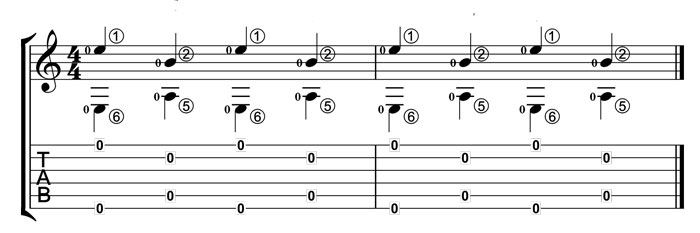
Once this is flowing and consistent, we can move to step two.
Step Two
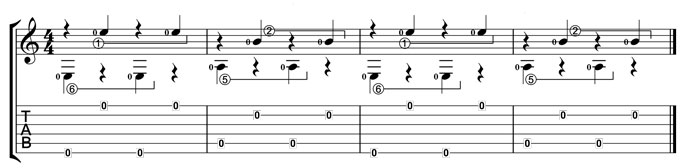
Here we offset the two pairs from Step One.
Instead of playing strings 1 and 6 together, play them one at a time. 6 then 1.
And the same with strings 5 and 2.
So the full pattern moves in string order: 6–1–5–2 in a steady loop.
Other Chords with the Pattern
The G chord in our example uses all six strings. Many chords use only 5 or 4 strings. For these, we have a formula.
The root of the chord (the note for which the chord is named) is in the bass. This means that the lowest note of the chord is on the first beat.
For example, the A and C chords use five strings. The pattern for these will be: 5–1–4–2
The D and F chords use four strings. The pattern for these is: 4–1–3–2
With a little practice, this pattern can become habitual and intuitive. We can add it to our muscle memory and play through our chord songs with fluid grace and ease.

Hi, I’m Allen Mathews.
I started as a folk guitarist, then fell in love with classical guitar in my 20’s. Despite a lot of practice and schooling, I still couldn’t get my music to flow well. I struggled with excess tension. My music sounded forced. And my hands and body were often sore. I got frustrated, and couldn’t see the way forward. Then, over the next decade, I studied with two other stellar teachers – one focused on the technical movements, and one on the musical (he was a concert pianist). In time, I came to discover a new set of formulas and movements. These brought new life and vitality to my practice. Now I help guitarists find more comfort and flow in their music, so they play more beautifully.
Click here for a sample formula.
Hello Allen,
I feel my guitar proficiency is improving considerably. Every day I’m exceedingly comfortable with my right hand technique and overall fluency. And my sight-reading has improved as well. Thank you for creating the Woodshed. It’s thoughtful construction and scope and sequence of knowledge and skills has advanced my guitar skills significantly. I can’t wait to see what the future holds.
~ Michael Immel
-Michael Immel
Thanks to you (you are my only teacher) in only a few months I've gone from very basic beginner pieces to having just completed learning Bach's Gavottes 1&2 in good form and execution. As a non-classical electric guitarist who has always used a pick and never his fingers, this has been no small feat!
~ Gregg Olson
-Gregg Olson
“Success lies in relentless execution of the basics.”
Join the program that takes you from the beginning fundamentals to advanced mastery, so you…
- Move your hands safely and fluidly
- Enjoy fulfilling practices and meaningful work
- Play beautifully with expression and flow
Click the button to take a step towards an
organized, effective guitar practice. >>>