
The 6-Minute Guitar Practice Formula
Ever find yourself saying you don’t have time to practice guitar? Think again!
Just six dedicated minutes can make a real difference in your playing.
The key is how you practice, not how long.
The Magic of Micro-Practice Sessions
Good practice is all about laser-sharp focus. With a clear plan, even short practice sessions can lead to significant progress.
Think of it as a “micro-workout” for your guitar skills.
Download the Practice Planner PDF
Your Six-Minute Practice Blueprint
Here’s a simple six-minute routine to keep your skills sharp and your progress steady.
Feel free to adapt these general ideas to your current level and goals.
Minute 1: Finger Independence
Start by waking up your fingers with exercises that train each one to move independently.
Place one finger per fret and keep your thumb behind your second finger. Then, lift each finger slowly and carefully, one by one.
Keep an eye out for other fingers trying to join the party. If you see them moving when they shouldn’t, slow down.
This is exactly the kind of challenge that builds control. Keep it challenging, but not too much so.
Feeling confident? Try the “spider walk.” This involves moving each finger across the strings, one at a time, without lifting the others. It’s a great way to improve dexterity.
Minute 2: Right-Hand Practice
Spend this minute working only on your right (picking) hand.
Play one string at a time in a steady pattern.
Keep it simple. Don’t worry about complicated chords with your left hand.
Focus on precise, even strokes. Allow for follow-through.
Strive to play each note at the same volume with a rock-solid beat.
Minute 3: Scale Mastery
During your scale minute, choose one scale and focus on precision rather than speed.
If you’re a beginner, you can start with a simple 1–2–3–4 pattern up and down each string.
More experienced players, focus on:
- A smooth, steady tone.
- Keeping your fingers at the same height.
- Maintaining that perfect “C” shape with your left hand.
Pay special attention to finger placement. For the best sound, place each finger right behind the fret.
Watch out for flying fingers, especially your pinky. If it’s lifting far off the fretboard, dedicate this minute to taming it.
Download the Guitar Practice Planner PDF Resource
Minute 4: Slur Techniques
Practice your hammer-ons and pull-offs, starting with your weakest finger combinations.
Listen carefully to the duration of each note, especially on pull-offs.
The goal is a smooth, connected, and musical sound.
As you improve, incorporate different finger combinations. Try finger combinations like:
- 1–2
- 2–3
- 3–4
- 1–3
- 2–4
- 1-4
Minute 5: Barré Chord Strength
This minute is for building strong, clear barré chords. Whether you’re new to two-string barrés or already playing full chords, there’s always room to grow.
Start slowly and deliberately. There’s no need to rush.
Begin with two strings and add more as you gain confidence.
Already a barré chord pro? Focus on playing with greater ease and efficiency.
Experiment with using less pressure but keeping a clear, ringing sound. Practice “bouncing” (moving quickly) between barré chords. This helps relax your hand and get it ready for the next chord.
Minute 6: Problem-Solving
Now it’s time to practice a tricky spot in a piece you’ve been working on.
It might be just a few notes that resist polish. That’s perfect – this is your chance to make it better.
Here are some ways to practice it:
- Play it extra slowly and listen to each note.
- Practice one hand at a time.
- Try different rhythms.
- Use the Add-A-Note method
The possibilities abound.
Paulo Coelho once said:
“Any mistake you repeat more than once is a choice.”
This means if we keep making the same mistake without trying to fix it, we’re choosing not to get better.
This minute is the perfect opportunity to choose to improve. Because by now you’ve warmed up, you’re focused, and who knows? You might have a breakthrough.
Making It Work
The key to success with this routine is preparation. Using a timer app that chimes every minute will help to avoid the distraction of watching the clock.
Know exactly what you’re going to practice before you grab your guitar.
This way, you won’t waste time figuring out what to do. Jot down your plan and keep it with your guitar.
Download the Guitar Practice Planner
Moving Forward
You can start this routine today but don’t feel locked into it forever. As your playing improves, switch it up. You should keep things interesting and challenging.
Even if you’re short on time, these six minutes of dedicated practice will connect you to your playing. You’ll maintain momentum and get better over time.

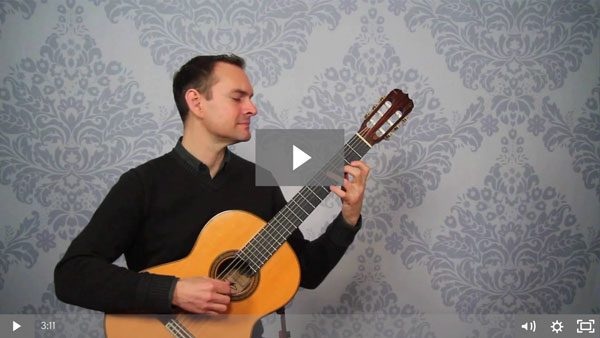
Hi, I’m Allen Mathews.
I started as a folk guitarist, then fell in love with classical guitar in my 20’s. Despite a lot of practice and schooling, I still couldn’t get my music to flow well. I struggled with excess tension. My music sounded forced. And my hands and body were often sore. I got frustrated, and couldn’t see the way forward. Then, over the next decade, I studied with two other stellar teachers – one focused on the technical movements, and one on the musical (he was a concert pianist). In time, I came to discover a new set of formulas and movements. These brought new life and vitality to my practice. Now I help guitarists find more comfort and flow in their music, so they play more beautifully.
Click here for a sample formula.
I am a 61 year old physician, reconnecting with the classical guitar after a hiatus of nearly 40 years. After a couple of weeks [in the program], I’m now producing a much clearer, yet somehow more mellow and beautiful sound. It was really good to feel it happening in my hand, and that it felt more comfortable and somehow “right”, compared to the way I had played before (“curved picking”). The fog started to lift and I found that I was remembering more, and it felt great (also a bit of a relief!), giving me confidence to keep going. Thank you for making your course available - your love of music and the guitar shines through the teaching. I am very happy I found and registered with CGS.
~ Brian Davey
-Brian Davey
Since a year ago with my subscription to CGS it has been for me a pleasurable adventure and a discovery of all the facets of the classical guitar.
Your dedication and enthusiasm, as well as your talent, in the tuition is quite contagious (well, lets hope also for your talent) and has made it fun and useful in my progression. Also the weekly tip that you mail us and the Facebook group is excellent.
~ Michel Donnet
-Michel Donnet
“Success lies in relentless execution of the basics.”
Join the program that takes you from the beginning fundamentals to advanced mastery, so you…
- Move your hands safely and fluidly
- Enjoy fulfilling practices and meaningful work
- Play beautifully with expression and flow
Click the button to take a step towards an
organized, effective guitar practice. >>>