How to Play the D# Chord on Guitar (also called Eb)
- Step 1: Finger 1 on the 3rd fret of the third string (g string)
- Step 2: Finger 2 on the 3rd of the first string (e string)
- Step 3: Finger 3 on the 4th fret of the second string (b string)
- The sixth, fifth, and fourth strings are not played
- We can place the right-hand thumb on the third string and strum toward the floor
D# Minor Chord (easy)
Let’s look at the diagram for the D# minor chord.
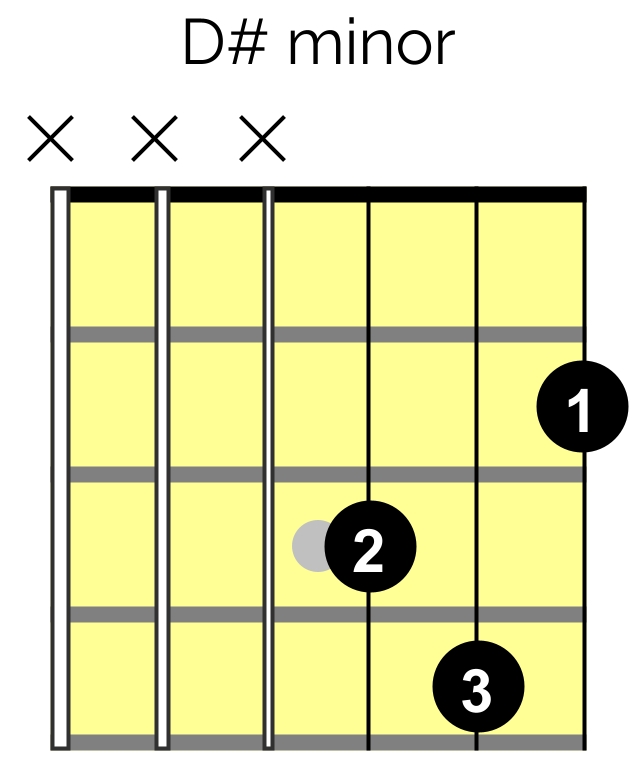
D# minor chord
Steps to Play a D#m Chord:
- Step 1: Finger 1 on the 2nd fret of the first string (e string)
- Step 2: Finger 2 on the 3rd fret of the third string (g string)
- Step 3: Finger 3 on the 4th fret of the second string (b string)
- The sixth, fifth, and fourth strings are not played
- We can place the right-hand thumb on the third string and strum down
D# Chord (easy alternative)
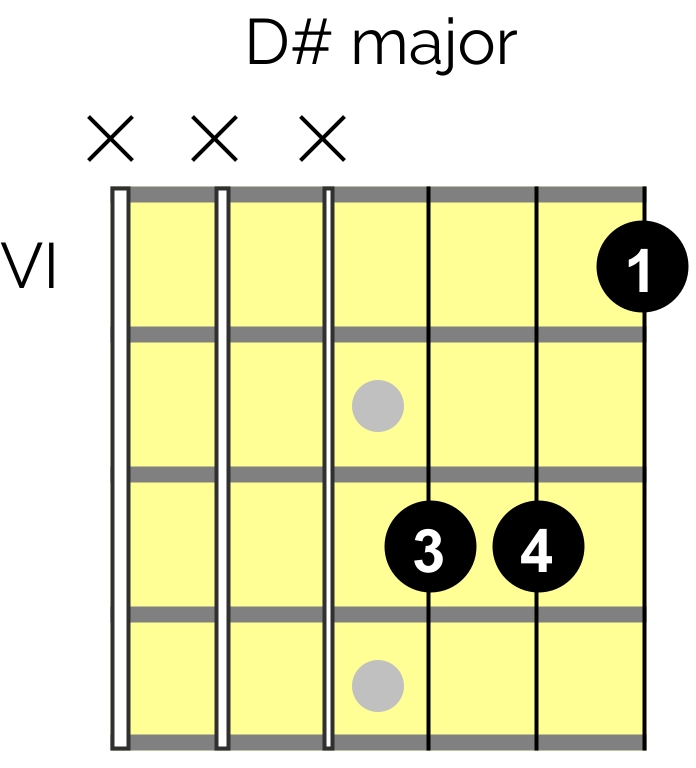
D# major chord
To the right is an example of a D# chord with an alternate fingering (voicings).
- Step 1: First finger on the 6th fret of the first string (e string)
- Step 2: Third finger on the 8th fret of the third string (g string)
- Step 3: Fourth finger on the 8th fret of the second string (b string)
- The sixth, fifth and fourth strings are not played
- With our right hand, we can place our thumb on the third string, and strum
Music Theory: What is a Chord?
Theory is a tool that can help us better understand music. Theory explains how notes and chords work together to create the music we know and love.
Do we need to learn music theory? No. At least not as beginners. Practicing chords and learning to use our hands on the guitar is more important. All the abstract background knowledge can come later.
But if you are interested, we’ll discuss the musical alphabet in this section.
The musical alphabet uses only the notes named A, B, C, D, E, F, and G.
These notes can be altered by raising or lowering the pitch. We call this making a note “sharp” (raising) or “flat” (lowering).
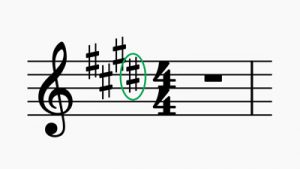
Sharps
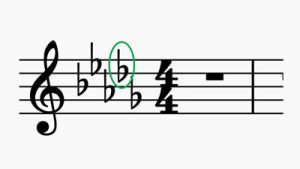
Flats
- On the guitar, we sharpen a note by moving one fret higher
- To flatten a note, we move one fret lower
In all, this gives us 12 notes. These same 12 notes repeat going higher and/or lower. Think of the same pattern of black notes (groups of two and three) repeating up the length of a piano.
A piece of music rarely uses all 12 notes. Instead, we limit the notes to a “key.” A key is a unique collection of seven notes. The name of the next note in the series (the 8th note) is the same as the first. The eight notes form an “octave”.
The Key of D# for example, contains the notes:
D#, E#, Fx (double-sharp), G#, A#, B#, Cx, D#
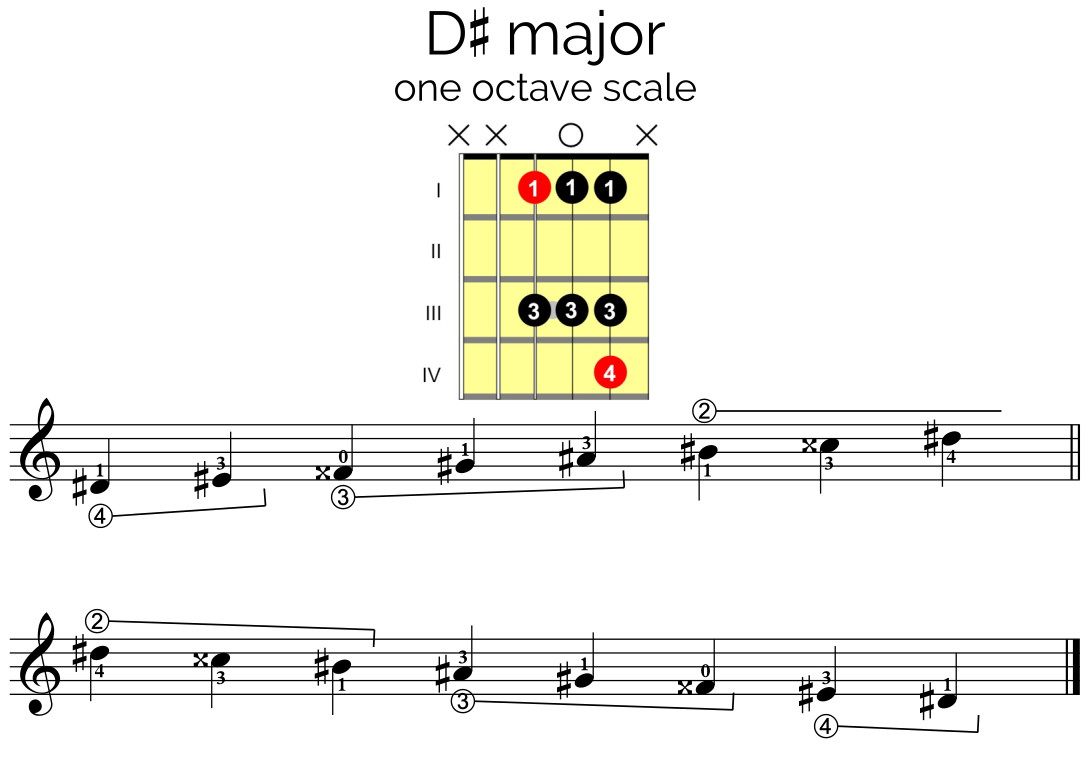
D Sharp Major Scale
This is the D# Major scale. To create the D# chord, we take the 1st, 3rd, and 5th notes from this group of notes.
So the notes in the D# Major Chord are: D#, Fx, A#.
The key of Eb, for example, contains the notes:
Eb, F, G, Ab, Bb, C, D, Eb.
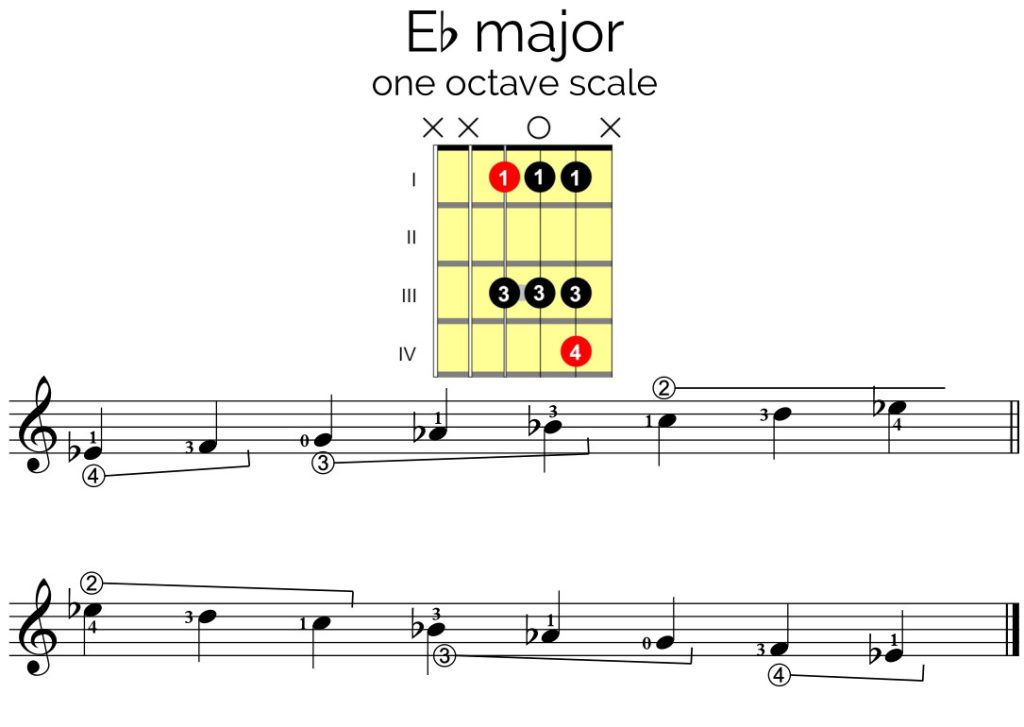
E flat Major Scale
This is the Eb major scale. It is the enharmonic equivalent to D# (i.e. the same pitches, just written differently).
To create the Eb chord, we take the 1st, 3rd, and 5th notes: Eb, G, and Bb.
We can play these notes in any combination all over the fretboard. As long as we play these notes together, we are playing an Eb Major chord (or just “Eb chord”).
There’s more to learn about the relationship between chords and scales.
Chords that Sound Good with the D# chord
The most common chords played with the D# Major chord are:
A# Major Chord (also known as Bb)
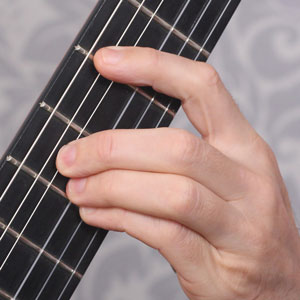
Play this on the 1st fret for the A# Major Chord
G# Major Chord (also known as Ab)
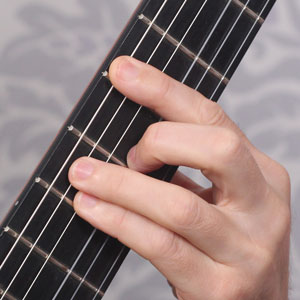
Play this shape in the 4th fret for the G# major chord
A#7 Chord (also known as Bb7)
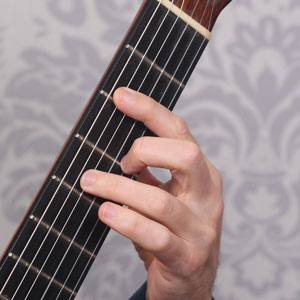
Play this shape on the 1st fret for the A#7 chord
Other chords that sound good with D# Major are:
C Minor Chord
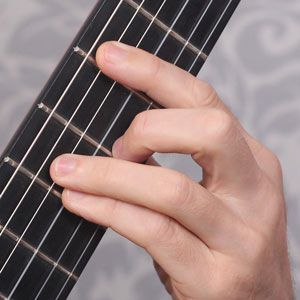
Play this shape on the 3rd fret for the C minor chord
F Major Chord
Play this shape in the 1st fret for the F major chord
Because the D# major scale contains lots of sharps, it’s easier to think of it as a scale in Eb. (D# and Eb major scales sound the same, but their notes are labeled differently.)
We can find notes to all these chords within the Eb major scale. The chords can appear in any order and duration, depending on the piece or song.
One of the best skills we can learn as guitarists is how to practice chords. It’s helpful to be able to switch quickly between chord shapes.
Chord Progressions
A chord progression is one chord moving to another chord. Most songs in Western music follow a chord progression.
Chord progressions can link as few as two chords together, or many different chords.
Here are two common chord progressions:
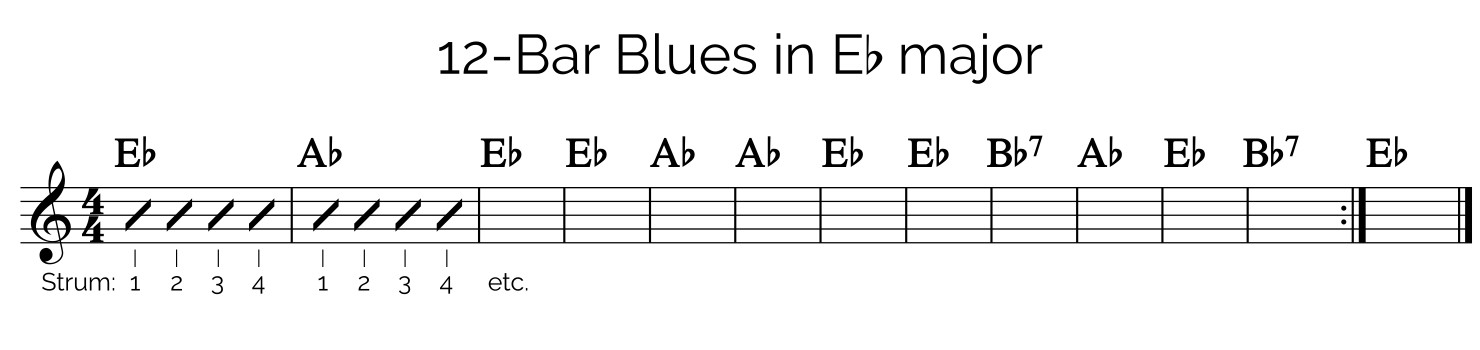
12-Bar Blues Progression in Eb Major (aka D# Major)
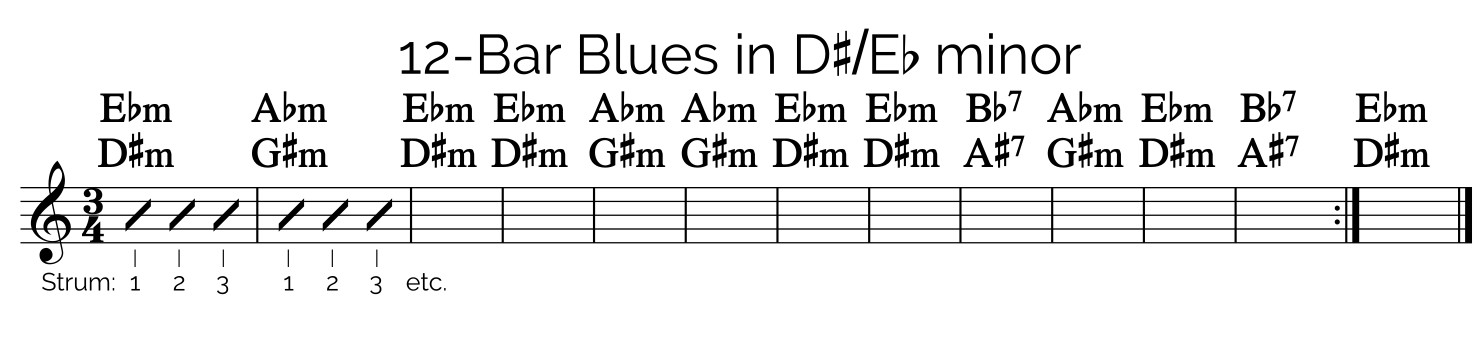
12-Bar Blues Progression in D# minor (aka Eb minor)
You can also create your own songs or pieces by putting together chords in any way you like.
Popular Pieces With the D# Chord
The D# chord appears in many songs and pieces of music, but as we’ve learned, it’s usually labeled Eb. From Albeniz to ABBA, Eb or Ebm chords are commonly used across time, culture, and genre.
Popular pieces that incorporate Eb/D# chords include:
- Augustin Barrios – “Prelude in C Minor”
- Fernando Sor – “Etude, Op.29 No.13”
- J.S. Bach – “Prelude, Fugue, and Allegro in E-flat Major, BWV 998”
- Fernando Sor – “Etude, Op.29 No.22”
- Tchaikovsky – “1812 Overture”
- Elton John – “Your Song”
- Adele – “Someone Like You”
- Step 1: Finger 1 on the 6th fret of the fifth (a) and first (e) strings (see selective pressure above)
- Step 2: Finger 2 on the 8th fret of the fourth string (d string)
- Step 3: Finger 3 on the 8th fret of the third string (g string)
- Step 4: Finger 4 on the 8th fret of the second string (b string)
- The sixth string (e) is not played
- We can place the right-hand thumb on the fifth string and strum
The D# Minor Full Barre Chord Diagram
We can also use a barre to play a D# minor chord shape.
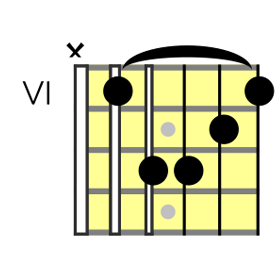
D# Minor Chord
Steps to Play the D# Minor Barre Chord:
- Step 1: Finger 1 on the 6th fret of the fifth (a) and first (e) strings
- Step 2: Finger 2 on the 7th fret of the second (b) string
- Step 3: Finger 3 on the 8th fret of the fourth (d) string
- Step 4: Finger 4 on the 8th fret of the third (g) string
- The sixth string (e) is not played
Is There An Easy D# Chord on Guitar?
Playing bar chords is difficult to begin with.
But we don’t have to perfect this tricky chord shape before we can play a D# in a song. We can use the easier version shown above.
And we can also discover other finger combinations to play D#. We call this alternate fingering or alternative “voicing”.
Below, you’ll discover three easy alternative fingerings for the D Sharp chord. Here are two alternatives for the D sharp Major chord and one alternative for the D sharp Minor chord:
D# Chord (easy)
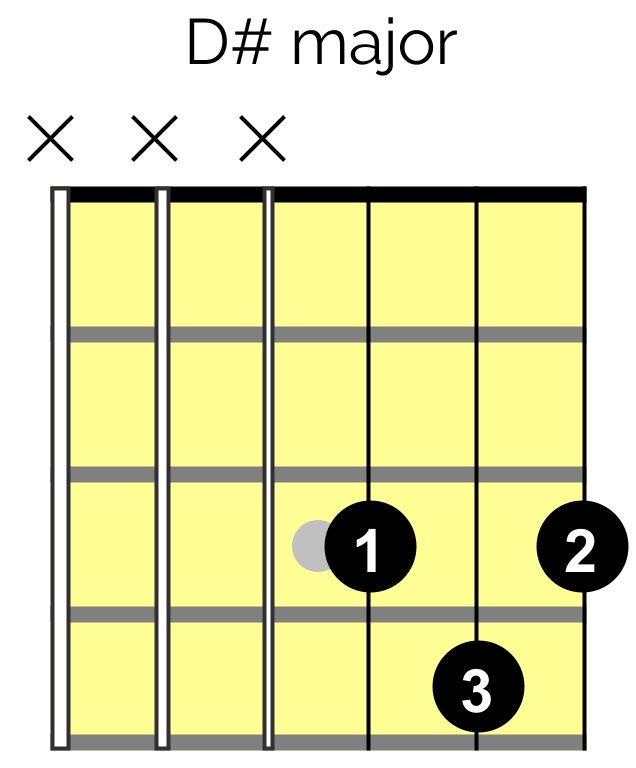
D# major chord
Steps to Play the D# Chord:
- Step 1: Finger 1 on the 3rd fret of the third string (g string)
- Step 2: Finger 2 on the 3rd of the first string (e string)
- Step 3: Finger 3 on the 4th fret of the second string (b string)
- The sixth, fifth, and fourth strings are not played
- We can place the right-hand thumb on the third string and strum toward the floor
D# Minor Chord (easy)
Let’s look at the diagram for the D# minor chord.
D# minor chord
Steps to Play a D#m Chord:
- Step 1: Finger 1 on the 2nd fret of the first string (e string)
- Step 2: Finger 2 on the 3rd fret of the third string (g string)
- Step 3: Finger 3 on the 4th fret of the second string (b string)
- The sixth, fifth, and fourth strings are not played
- We can place the right-hand thumb on the third string and strum down
D# Chord (easy alternative)
D# major chord
To the right is an example of a D# chord with an alternate fingering (voicings).
- Step 1: First finger on the 6th fret of the first string (e string)
- Step 2: Third finger on the 8th fret of the third string (g string)
- Step 3: Fourth finger on the 8th fret of the second string (b string)
- The sixth, fifth and fourth strings are not played
- With our right hand, we can place our thumb on the third string, and strum
Music Theory: What is a Chord?
Theory is a tool that can help us better understand music. Theory explains how notes and chords work together to create the music we know and love.
Do we need to learn music theory? No. At least not as beginners. Practicing chords and learning to use our hands on the guitar is more important. All the abstract background knowledge can come later.
But if you are interested, we’ll discuss the musical alphabet in this section.
The musical alphabet uses only the notes named A, B, C, D, E, F, and G.
These notes can be altered by raising or lowering the pitch. We call this making a note “sharp” (raising) or “flat” (lowering).
Sharps
Flats
- On the guitar, we sharpen a note by moving one fret higher
- To flatten a note, we move one fret lower
In all, this gives us 12 notes. These same 12 notes repeat going higher and/or lower. Think of the same pattern of black notes (groups of two and three) repeating up the length of a piano.
A piece of music rarely uses all 12 notes. Instead, we limit the notes to a “key.” A key is a unique collection of seven notes. The name of the next note in the series (the 8th note) is the same as the first. The eight notes form an “octave”.
The Key of D# for example, contains the notes:
D#, E#, Fx (double-sharp), G#, A#, B#, Cx, D#
D Sharp Major Scale
This is the D# Major scale. To create the D# chord, we take the 1st, 3rd, and 5th notes from this group of notes.
So the notes in the D# Major Chord are: D#, Fx, A#.
The key of Eb, for example, contains the notes:
Eb, F, G, Ab, Bb, C, D, Eb.
E flat Major Scale
This is the Eb major scale. It is the enharmonic equivalent to D# (i.e. the same pitches, just written differently).
To create the Eb chord, we take the 1st, 3rd, and 5th notes: Eb, G, and Bb.
We can play these notes in any combination all over the fretboard. As long as we play these notes together, we are playing an Eb Major chord (or just “Eb chord”).
There’s more to learn about the relationship between chords and scales.
Chords that Sound Good with the D# chord
The most common chords played with the D# Major chord are:
A# Major Chord (also known as Bb)
Play this on the 1st fret for the A# Major Chord
G# Major Chord (also known as Ab)
Play this shape in the 4th fret for the G# major chord
A#7 Chord (also known as Bb7)
Play this shape on the 1st fret for the A#7 chord
Other chords that sound good with D# Major are:
C Minor Chord
Play this shape on the 3rd fret for the C minor chord
F Major Chord
Play this shape in the 1st fret for the F major chord
Because the D# major scale contains lots of sharps, it’s easier to think of it as a scale in Eb. (D# and Eb major scales sound the same, but their notes are labeled differently.)
We can find notes to all these chords within the Eb major scale. The chords can appear in any order and duration, depending on the piece or song.
One of the best skills we can learn as guitarists is how to practice chords. It’s helpful to be able to switch quickly between chord shapes.
Chord Progressions
A chord progression is one chord moving to another chord. Most songs in Western music follow a chord progression.
Chord progressions can link as few as two chords together, or many different chords.
Here are two common chord progressions:
12-Bar Blues Progression in Eb Major (aka D# Major)
12-Bar Blues Progression in D# minor (aka Eb minor)
You can also create your own songs or pieces by putting together chords in any way you like.
Popular Pieces With the D# Chord
The D# chord appears in many songs and pieces of music, but as we’ve learned, it’s usually labeled Eb. From Albeniz to ABBA, Eb or Ebm chords are commonly used across time, culture, and genre.
Popular pieces that incorporate Eb/D# chords include:
- Augustin Barrios – “Prelude in C Minor”
- Fernando Sor – “Etude, Op.29 No.13”
- J.S. Bach – “Prelude, Fugue, and Allegro in E-flat Major, BWV 998”
- Fernando Sor – “Etude, Op.29 No.22”
- Tchaikovsky – “1812 Overture”
- Elton John – “Your Song”
- Adele – “Someone Like You”
How to play the D Sharp (E Flat) Chord on guitar
D# is not commonly found on our guitar chord progression charts. We usually prefer to call it Eb instead, as the two chords use the same notes, and Eb is easier to read in musical notation.
But if we’re strumming a song and find D# in the cropping up in the chords, it’s good to know a couple of ways to play it.
In this article, we explore:
- Easy ways to play D# guitar chord shapes
- How to play a barre guitar chord – and why it can be challenging
- How to make the D# barre chord easier to play and sound cleaner
Table of contents
- What is a D# Chord on Guitar?
- How to Play D Sharp Major and Minor Guitar Chords
- How to Understand Chord Diagrams
- D Sharp Major Chord
- D# Minor Chord
- Barre Chords
- Is There An Easy D# Chord on Guitar?
- Music Theory: What is a Chord?
- Chords that Sound Good with the D# chord
- Chord Progressions
- Popular Pieces With the D# Chord
What is a D# (or Eb) Chord on Guitar?
The D# guitar chord consists of three notes (or “chord tones”): D#, G and A#. The first note (D#) is called the “root note”. And together, these three notes are known as a “major triad”.
They form the D# major guitar chord, commonly known as “D#”. (See Music Theory: What is a Chord?)
Nerdy note: The scale of D# major is not normally used in practical music-making as the theory behind it is very cumbersome. It involves lots of sharps and even double sharps.
In fact, the note G does not officially occur in the D# major triad. The correct name is F## (double sharp, also written as Fx). But the note F## sounds exactly the same as G (known as its “enharmonic equivalent”), so we like to use the easier label.
How to Play D Sharp Major and Minor Guitar Chords
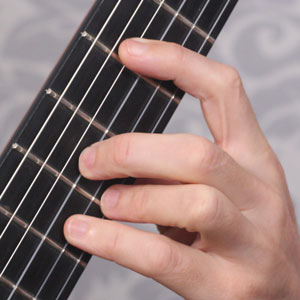
Play this shape on the 1st fret for the D Sharp Major Chord
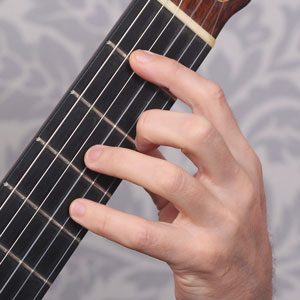
D Sharp Minor Chord
The image to the left is a D-sharp major chord shape. The image to the right is a D-sharp minor chord.
If we listen to the two chords one after the other, we’ll hear the difference. It’s only one note, but it gives each chord a distinct “quality”.
Major chords can be said to sound “happy” and minor chords are sometimes described as “sad”.
To learn how to play these guitar chord shapes, we can use a chord diagram.
How to Understand Chord Diagrams
A chord diagram is a useful tool. It tells us which strings to play, and which fingers to use.
The Left-Hand Fingers
We number the left-hand fingers 1 to 4.
1 is the first finger (index or pointer finger). 2 is the second finger, and so on.
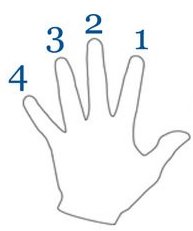
Left Hand Fingers
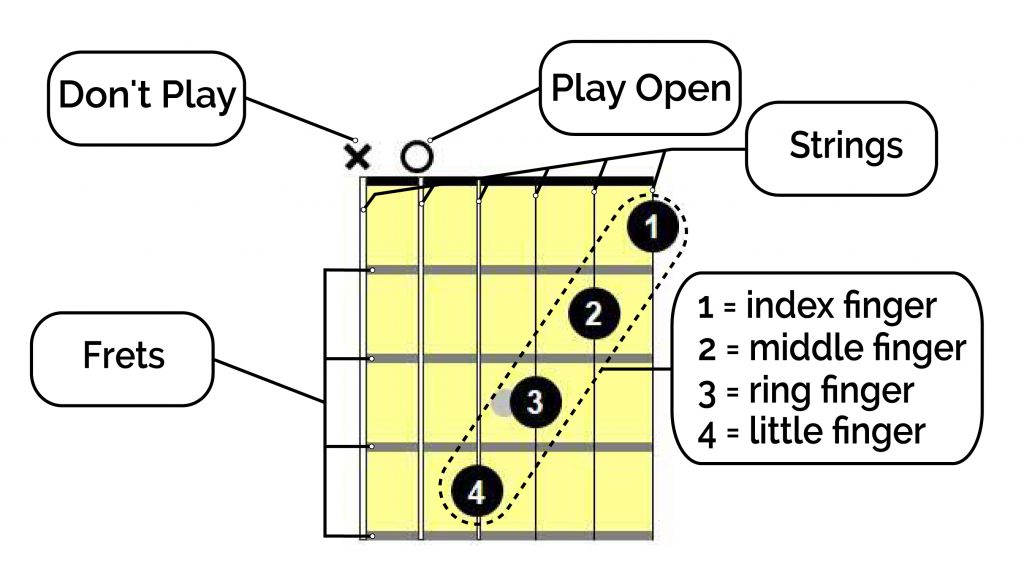
How to read a Chord Diagram
D Sharp Major Chord
Let’s use the diagram to look at our first chord shape: the D sharp major chord.
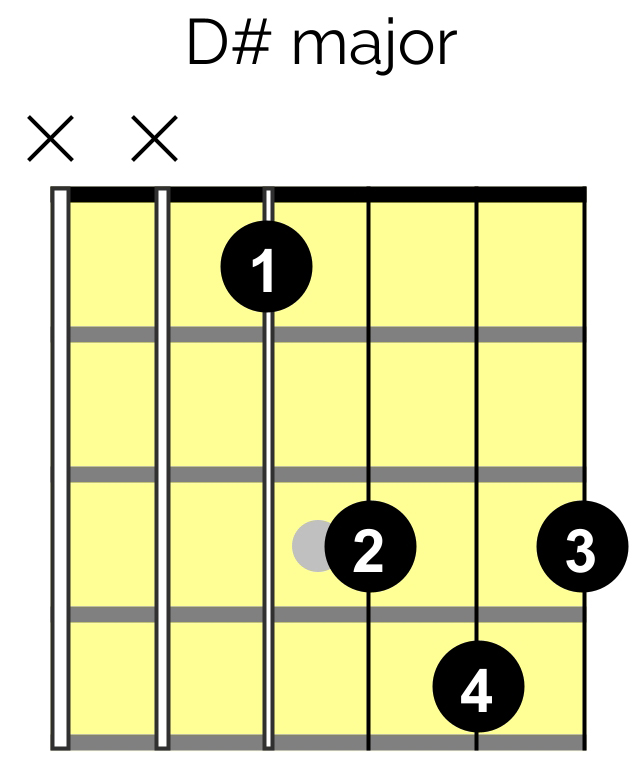
D# major in root position
Steps to Play the D# Chord:
- Step 1: Finger 1 on the 1st fret of the fourth string (d string)
- Step 2: Finger 2 on the 3rd fret of the third string (g string)
- Step 3: Finger 3 on the 3rd of the first string (e string)
- Step 4: Finger 4 on the 4th fret of the second string (b string)
- The sixth, fifth, and fourth strings are not played
- We can place the right-hand thumb on the third string and strum toward the floor
This is the same shape we often use for D major, but in a different position, one fret up. It is important not to play the fourth string (D) because it clashes with the D#.
D# Minor Chord
Let’s look at the diagram for the D# minor chord.
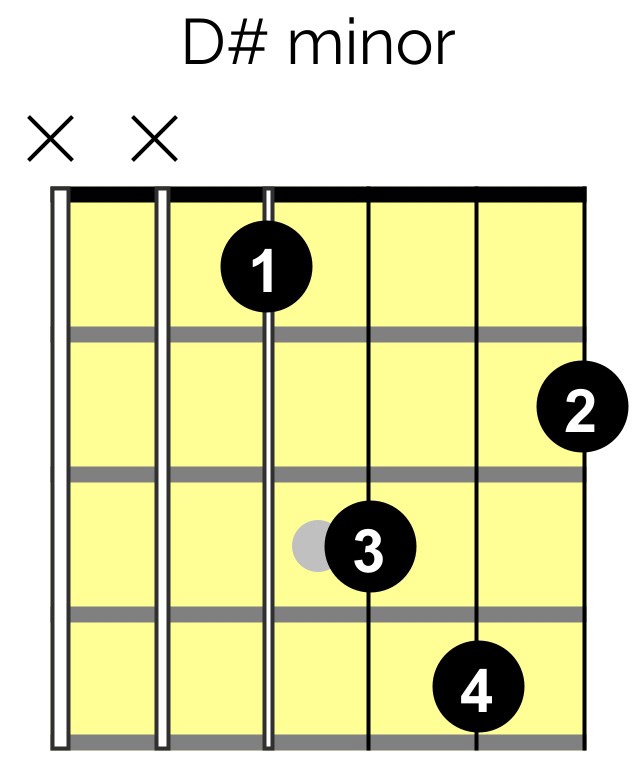
D# minor in root position
Steps to Play a D#m Chord:
- Step 1: Finger 1 on the 1st fret of the fourth string (d string)
- Step 2: Finger 2 on the 2nd fret of the first string (e string)
- Step 3: Finger 3 on the 3rd fret of the third string (g string)
- Step 4: Finger 4 on the 4th fret of the second string (b string)
- The sixth, fifth, and fourth strings are not played
- We can place the right-hand thumb on the third string and strum down
Barre Chords
Note for beginners: Feel free to skip this section. You can return to it later if you choose.
A bar (barre) chord substitutes the guitar nut (fret zero) with the first finger. This acts like a capo. The first finger lies across two or more strings, while the other fingers fret other notes.
Playing barre chords can be difficult. We tend to press too hard. Our fretting hand can get tired quickly. And we can mute strings by mistake or get unwanted buzzing sounds.
With the right technique, we can play bar chords more easily.
The D# Major Full Barre Chord Diagram
We can use a full barre to play a D# major chord shape.
This is harder than the shape above. But because we use all the strings, this version enriches the chord with added bass notes.
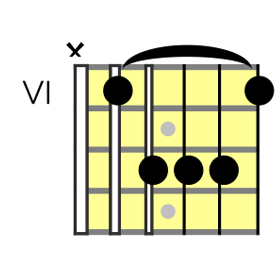
D# Major Chord
Steps to Play the Full D# Major Barre Chord:
- Step 1: Finger 1 on the 6th fret of the fifth (a) and first (e) strings (see selective pressure above)
- Step 2: Finger 2 on the 8th fret of the fourth string (d string)
- Step 3: Finger 3 on the 8th fret of the third string (g string)
- Step 4: Finger 4 on the 8th fret of the second string (b string)
- The sixth string (e) is not played
- We can place the right-hand thumb on the fifth string and strum
The D# Minor Full Barre Chord Diagram
We can also use a barre to play a D# minor chord shape.
D# Minor Chord
Steps to Play the D# Minor Barre Chord:
- Step 1: Finger 1 on the 6th fret of the fifth (a) and first (e) strings
- Step 2: Finger 2 on the 7th fret of the second (b) string
- Step 3: Finger 3 on the 8th fret of the fourth (d) string
- Step 4: Finger 4 on the 8th fret of the third (g) string
- The sixth string (e) is not played
Is There An Easy D# Chord on Guitar?
Playing bar chords is difficult to begin with.
But we don’t have to perfect this tricky chord shape before we can play a D# in a song. We can use the easier version shown above.
And we can also discover other finger combinations to play D#. We call this alternate fingering or alternative “voicing”.
Below, you’ll discover three easy alternative fingerings for the D Sharp chord. Here are two alternatives for the D sharp Major chord and one alternative for the D sharp Minor chord:
D# Chord (easy)
D# major chord
Steps to Play the D# Chord:
- Step 1: Finger 1 on the 3rd fret of the third string (g string)
- Step 2: Finger 2 on the 3rd of the first string (e string)
- Step 3: Finger 3 on the 4th fret of the second string (b string)
- The sixth, fifth, and fourth strings are not played
- We can place the right-hand thumb on the third string and strum toward the floor
D# Minor Chord (easy)
Let’s look at the diagram for the D# minor chord.
D# minor chord
Steps to Play a D#m Chord:
- Step 1: Finger 1 on the 2nd fret of the first string (e string)
- Step 2: Finger 2 on the 3rd fret of the third string (g string)
- Step 3: Finger 3 on the 4th fret of the second string (b string)
- The sixth, fifth, and fourth strings are not played
- We can place the right-hand thumb on the third string and strum down
D# Chord (easy alternative)
D# major chord
To the right is an example of a D# chord with an alternate fingering (voicings).
- Step 1: First finger on the 6th fret of the first string (e string)
- Step 2: Third finger on the 8th fret of the third string (g string)
- Step 3: Fourth finger on the 8th fret of the second string (b string)
- The sixth, fifth and fourth strings are not played
- With our right hand, we can place our thumb on the third string, and strum
Music Theory: What is a Chord?
Theory is a tool that can help us better understand music. Theory explains how notes and chords work together to create the music we know and love.
Do we need to learn music theory? No. At least not as beginners. Practicing chords and learning to use our hands on the guitar is more important. All the abstract background knowledge can come later.
But if you are interested, we’ll discuss the musical alphabet in this section.
The musical alphabet uses only the notes named A, B, C, D, E, F, and G.
These notes can be altered by raising or lowering the pitch. We call this making a note “sharp” (raising) or “flat” (lowering).
Sharps
Flats
- On the guitar, we sharpen a note by moving one fret higher
- To flatten a note, we move one fret lower
In all, this gives us 12 notes. These same 12 notes repeat going higher and/or lower. Think of the same pattern of black notes (groups of two and three) repeating up the length of a piano.
A piece of music rarely uses all 12 notes. Instead, we limit the notes to a “key.” A key is a unique collection of seven notes. The name of the next note in the series (the 8th note) is the same as the first. The eight notes form an “octave”.
The Key of D# for example, contains the notes:
D#, E#, Fx (double-sharp), G#, A#, B#, Cx, D#
D Sharp Major Scale
This is the D# Major scale. To create the D# chord, we take the 1st, 3rd, and 5th notes from this group of notes.
So the notes in the D# Major Chord are: D#, Fx, A#.
The key of Eb, for example, contains the notes:
Eb, F, G, Ab, Bb, C, D, Eb.
E flat Major Scale
This is the Eb major scale. It is the enharmonic equivalent to D# (i.e. the same pitches, just written differently).
To create the Eb chord, we take the 1st, 3rd, and 5th notes: Eb, G, and Bb.
We can play these notes in any combination all over the fretboard. As long as we play these notes together, we are playing an Eb Major chord (or just “Eb chord”).
There’s more to learn about the relationship between chords and scales.
Chords that Sound Good with the D# chord
The most common chords played with the D# Major chord are:
A# Major Chord (also known as Bb)
Play this on the 1st fret for the A# Major Chord
G# Major Chord (also known as Ab)
Play this shape in the 4th fret for the G# major chord
A#7 Chord (also known as Bb7)
Play this shape on the 1st fret for the A#7 chord
Other chords that sound good with D# Major are:
C Minor Chord
Play this shape on the 3rd fret for the C minor chord
F Major Chord
Play this shape in the 1st fret for the F major chord
Because the D# major scale contains lots of sharps, it’s easier to think of it as a scale in Eb. (D# and Eb major scales sound the same, but their notes are labeled differently.)
We can find notes to all these chords within the Eb major scale. The chords can appear in any order and duration, depending on the piece or song.
One of the best skills we can learn as guitarists is how to practice chords. It’s helpful to be able to switch quickly between chord shapes.
Chord Progressions
A chord progression is one chord moving to another chord. Most songs in Western music follow a chord progression.
Chord progressions can link as few as two chords together, or many different chords.
Here are two common chord progressions:
12-Bar Blues Progression in Eb Major (aka D# Major)
12-Bar Blues Progression in D# minor (aka Eb minor)
You can also create your own songs or pieces by putting together chords in any way you like.
Popular Pieces With the D# Chord
The D# chord appears in many songs and pieces of music, but as we’ve learned, it’s usually labeled Eb. From Albeniz to ABBA, Eb or Ebm chords are commonly used across time, culture, and genre.
Popular pieces that incorporate Eb/D# chords include:
- Augustin Barrios – “Prelude in C Minor”
- Fernando Sor – “Etude, Op.29 No.13”
- J.S. Bach – “Prelude, Fugue, and Allegro in E-flat Major, BWV 998”
- Fernando Sor – “Etude, Op.29 No.22”
- Tchaikovsky – “1812 Overture”
- Elton John – “Your Song”
- Adele – “Someone Like You”

Hi, I’m Allen Mathews.
I started as a folk guitarist, then fell in love with classical guitar in my 20’s. Despite a lot of practice and schooling, I still couldn’t get my music to flow well. I struggled with excess tension. My music sounded forced. And my hands and body were often sore. I got frustrated, and couldn’t see the way forward. Then, over the next decade, I studied with two other stellar teachers – one focused on the technical movements, and one on the musical (he was a concert pianist). In time, I came to discover a new set of formulas and movements. These brought new life and vitality to my practice. Now I help guitarists find more comfort and flow in their music, so they play more beautifully.
Click here for a sample formula.
Those videos on practicing the piece were just awesome, Allen! I've always thought that learning songs might be something completely different than practicing exercises, but the way you teach it makes it much easier than I thought. I'm positive that joining the Woodshed has been the best investment I've ever done for learning the classical guitar. Thank you so much for these lessons.
~ Ulysses Alexandre Alves
-Ulysses Alexandre Alves
I just started level 1C...I was able to look at a Carulli piece, albeit a simple one, and understand it. And that understanding allowed me to play it much more easily on the first run through, and I expect it will allow me to make it fully musical at tempo quite soon. That's a huge personal victory for me. Until very recently my mindset was: "Notes on a page. Jimi didn't need them and I don't either." But I ain't Jimi, and now I want those notes on a page.My work in CGS, even at these early levels, got me to that personal breakthrough. And that's given me more confidence that continued work will get me to greater places in due time. So to answer your question: yes, I absolutely feel like I'm making headway and moving forward in my playing. Thank you for that.~ Matthew Ecker
-
“Success lies in relentless execution of the basics.”
Join the program that takes you from the beginning fundamentals to advanced mastery, so you…
- Move your hands safely and fluidly
- Enjoy fulfilling practices and meaningful work
- Play beautifully with expression and flow
Click the button to take a step towards an
organized, effective guitar practice. >>>