
How to Strum a Guitar
Strumming is one of the oldest and most common guitar techniques. A true fundamental.
It is useful for every style and genre. From folk and rock to classical and jazz, every type of music uses strumming.
In this article, you’ll discover an easy way to master the art of strumming a guitar. Follow the simple steps below and you’ll be on your way. Repeat the steps daily, and you’ll quickly ingrain this fundamental guitar skill.
Table of Contents
- How to Learn to Strum a Guitar
- Two Strokes: Down and Up
- The Most Common Strum: Ghost 2 and 5
- Advanced Strumming
- Why Classical Guitarists Should Learn to Strum
How to Learn to Strum a Guitar
Guitarists learn to strum in various ways. Some use rote repetition. Others use musical notation and written instructions.
In the method below, we’ll first play the two basic strumming movements. Then we’ll count aloud and create repeatable patterns.
This way, you can easily remind yourself of the specific strumming pattern you intend to play.
But first, a couple of notes for the right hand.
Use your index finger, loosely held
Some players use a pick (plectrum). With an eye toward classical or fingerstyle (fingerpicking) guitar, we’ll use the first finger of the right hand to strum.
Holding the fingers loosely in the hand, allow the pointer finger to remain released out. We’ll use this finger to play through the strings.
If you’d like some added stability for this finger, you can place the thumb lightly behind the middle knuckle. No need to squeeze.
Note: You don’t need to hit all the strings every time
Using the wrist and arm, the finger will trace an arc through the strings. We need not strike every string every time.
Instead, allow the index finger to hit whatever strings it does. Let the finger remain loose and free, rather than stiff or locked.
Two Strokes: Down and Up
To begin, we have two different strokes.
The down-stroke moves from above the strings down towards the floor. The fingernail contacts the strings.
The up-stroke lifts the arm and hand back up towards the ceiling. Here, the flesh of the pointer finger contacts the strings.
We move from the elbow. The wrist remains supple and free. The forearm may rotate slightly back and forth.
Feel free to allow this arm movement to trace a large arc through the air.
When you’re ready, play down and up in a steady rhythm.
Steady Rhythm
The goal of strumming is to create a rhythmic pattern. To let this happen, keep the joints loose and in constant motion.
Do not focus on the sound or the strings. Instead, seek to keep the arm moving in a steady, comfortable movement. Up and down, even and continual.
You are now strumming!
Step One: Count to Eight
Next stop: creating patterns.
Music is organized into groups of beats. The most common group of beats is a set of four down-strokes and four up-strokes.
For ease, we can number these 1–8.
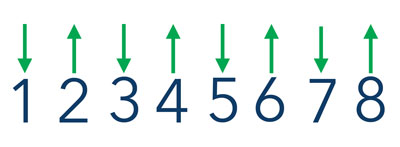
All the odd numbers are down-strokes. All the even numbers are up strokes.
For this step, count aloud as you play. 1 2 3 4 5 6 7 8.
You may be tempted to count silently to yourself. Resist this urge. Instead, use your voice. Say the numbers so that someone nearby could hear you.
(If you feel awkward using your voice aloud, practice courage and do it anyway. The self-consciousness is worth the result. You’ll learn faster and sound better for the temporary discomfort.)
Step Two: Ghost One Number
Once you can keep a steady rhythm while counting aloud 1–8 in a loop, you’re ready for the next step.
Now, we’ll miss the strings with one of the numbers. We can call this “ghosting” the note.
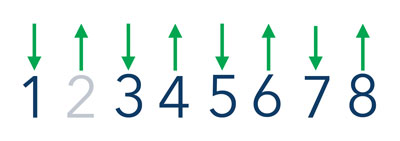
For example, say our number is 2. This means that we continue to count aloud. But for the up-stroke (number 2), we’ll move the arm up but miss the strings.
It is important to keep the arm moving up and down. Stopping will break the pattern.
If it helps, you can forcefully pull up your arm on the silent number. This feels as if you’re playing it louder (though you won’t touch the strings, so it will still be silent.)
Practice with all the numbers
You can practice ghosting each number in turn. This will help you get used to keeping your rhythm steady while counting and ghosting numbers.
Step Three: Ghost Two Numbers
Now you can ghost any of the numbers. Next step: ghost two numbers.
As before, keep your arm moving up and down in a steady rhythm. And keep counting aloud.
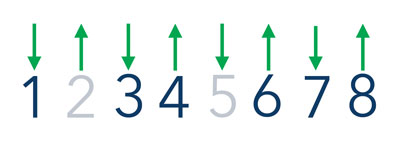
Choose any two numbers and ghost them. You may need to slow down to get the pattern in your ear and head.
You will grow more comfortable with this as you practice this strum. Especially if you continue to use your voice and count aloud.
The magic formula
Different styles of music often can be simplified into a pattern ghosting two numbers. For example, reggae ghosts the 3 and 7.
The most common pattern for popular and traditional music ghosts is the 2 and 5.
The Most Common Strum: Ghost 2 and 5
If you only master one pattern, let it be ghosting the 2 and 5. This pattern is used across the globe for many styles of popular and folk music.
As long as you keep your loose arm and wrist moving in a steady beat, you’ll recognize this strum instantly.
So it’s worth your while to give extra practice time to this pattern.
Add various chords in the left hand. Get comfortable continuing your steady arm movement while switching between chords.
Next-Level: Advanced Strumming Techniques
Accents for Dynamic Playing
In the strumming process above, we started simple and added complexity one step at a time. We’ll do the same here.
A good first variation to add is accents.
An accent is a note that is louder than the notes around it. It sticks out a bit from the general texture.
One of the best ways to make accented notes sound better is to play all the other notes more quietly.
So instead of just playing one strum louder, play everything at a lower volume. This way, the accented note will contrast more.
To play a strum more loudly, just move your arm and hand closer to the guitar. You’ll activate the strings more.
And if you like, you can stiffen your finger or pick (plectrum) on the accented beat.
Tip: Start with accenting the numbers before the ghost notes.
Let’s assume you’re ghosting beats as discussed above. The strum just before the ghosted beat is often great to accent.
So now, we have loud notes and quiet notes. Your strumming should already sound more “3-dimensional.”
Bass Notes: The Thumb Joins the Party
Next, we can add isolated bass notes with the thumb.
Your arm can keep the same up-down movement as before. But you may find yourself making smaller elbow movements and rotating the forearm more. No need to try to change anything here. Just notice what you naturally do as you speed up and add complexity.
Here’s how it works:
With the right-hand thumb, play the note of the current chord. Then complete the rest of the strumming pattern as usual.
Most often, we play the thumb bass on the count “1.” This is what a bass player would do in an ensemble setting.
You may also experiment with placing a bass note on other beats. The 5 is a good candidate.
And if playing more than one bass note on the same chord, you may like to alternate the lower notes of the chord. For example, moving between the 6th and 5th strings.
Percussive Sounds on Guitar
We can also introduce percussive sounds for added texture. These sounds could include tapping, knocking, slapping, or otherwise striking the guitar.
One common percussive technique brings the right hand into the strings. Think a sloppy karate chop. The strings hit the upper frets, making a metallic click.
We can do this without disrupting the down-up pattern. So we can retain all our other strumming details.
A few sounds to experiment with:
- Bass drum sound – use the side of the hand or the heel (near the wrist) to strike the bridge of the guitar. This creates a low boom sound. Amplified players sometimes play this sound just behind and below the bridge.
- Finger tap – tap the top of the guitar below the strings or neck. This is common in many styles. In Spanish guitar, it’s called a golpe. Some guitars have protection in this area so the player can tap with gusto.
- Side slap – Using the palm or fingers, slap the side of the guitar. We can slap the side of the guitar. Either hand can slap.
- String click – With the left-hand fingers, slap the strings. If the index finger stays on the strings, with the other three slapping lightly, we can mute any sustain. The result is a light click. This alternates well with any of the right-hand percussion sounds.
Play with freedom and experiment with sounds
Percussion on the guitar is great fun. Be brave and follow your curiosity. Get to know the different regions and strokes available.
Some composers do suggest specific percussive sounds. We can find them notated on the sheet music.
But for strumming and playing rhythm guitar, we can do whatever we choose. So have fun and keep playing “play.”
Why Classical Guitarists Should Learn to Strum
Strumming is one of the reasons that the guitar is the most popular instrument in the world. With a few chords and a strumming pattern, one can make music.
But many classical guitarists fail to learn to strum. Focused on other techniques, they may think less of the humble strum.
Below we’ll examine common myths about strumming. And you’ll hear why strumming is actually one of the best techniques to master on the guitar. (Even if you never plan to strum and sing popular songs.)
Common Myths About Strumming
Classical guitarists explore the complex world of composed music. As such, they may believe they are beyond such basics as strumming.
Then, myths may embed themselves like burrowing worms in the minds of the dedicated classical guitarist.
Here are some of the most common myths about strumming.
Myth #1: “Strumming is not serious”
As the thinking goes, strumming is just for informal campfire playing. If one’s main focus is on classical guitar music, strumming is slumming.
This is not true. Strumming is a common technique. The fact that it is commonly used in non-classical music does not devalue it.
A serious classical guitarist will only be better as a result of strumming practice. For the reasons listed below, this player will be more able to make the beautiful music desired.
Myth #2: “Strumming is for dabblers and hippies”
In this thought, using the strumming technique implies inclusion in a social group. And one not desired by the person thinking it.
It is true that many novices begin with strumming and do not progress further. For their needs, strumming is enough.
However, it is a logical fallacy to equate strumming with dilettantes and dabblers. That would be similar to this statement:
“Peasants eat bread. Therefore bread is just for peasants.”
Clearly not so.
Myth #3: “Classical guitar doesn’t use strumming”
Classical guitar music does indeed use strumming. Pieces from the Renaissance forward to today often use strumming patterns.
In classical music, strumming is often used as a spice, rather than the main dish. It may be used in a single section or for just a few notes or bars.
Spanish guitar music is well-known for its firey “rasgueado” strumming.
And in ensemble music, we may find even more strumming.
The better we use this technique, the more easily and musically we can play these pieces.
But strumming is helpful, even if we don’t play any pieces that use it.
Benefits of Strumming
When we consider strumming, we may think about the accompanimental quality of it. Whether playing along with vocals or another instrument, strumming is widely used.
But there are other benefits to the art of strumming. And we blossom as musicians as we embrace all aspects of the guitar.
Benefit #1: Rhythm training using large movements
It is easy to “lock down” and use excess tension playing classical guitar music. Our arms may not move much.
When strumming, however, we can release the larger muscles and use more fluid movements.
This helps us develop internal rhythm in a different way. We improve our internal pulse and sense of phrasing.
Benefit #2: Understanding how rhythm and music are organized
Strumming patterns occur over a full bar or more of music.
As we strum chords in a given progression, we discover larger musical forms. Instead of thinking about single beats, we think in larger groups. We feel and hear how phrases work over 4, 8, or 16 measures.
We also internalize strong and weak beats. We feel the larger pulse.
Benefit #3: Better feel in non-strumming music
In time, we strum with more freedom and a sense of pulse and meter. We can then bring this freedom and inflection to our composed music.
Even when the music has no strumming, we can improve the general feel and sweep of our tunes.
This removes the “stiff” sound that is so common among classical guitarists.
Benefit #4: Allows you to play with others
Whether playing duets, accompanying loved ones singing holiday carols, or joining a local guitar orchestra, strumming gives us a quick way to get involved.
If we can follow chord charts and lead sheets, we can learn a massive amount of music in record time.
Even if we intend to learn a composed accompaniment later, strumming can fill the gap in the meantime.
Benefit #5: Strumming occurs in classical guitar pieces as well
And as we said above, strumming does turn up in composed classical music as well.
When we can’t strum basic patterns in rhythm, this music falls flat. To stay most agile and versatile, strumming is a must.
Learn to Strum Your Guitar
If you are a guitarist who has not yet learned to strum, now is the time.
In just a few minutes a day for the next couple of weeks, you can build this skill to a sufficient level. No incense or headband required.
As you practice, let your goal be a sense of freedom and relaxation. Soften your eyes. Allow your body to move more than usual. And try to enjoy it.
Fair warning, you may feel uncomfortable. Like playing the tambourine, strumming may not be as easy as it looks. But with the method above, you’ll get it.
Have fun!

Hi, I’m Allen Mathews.
I started as a folk guitarist, then fell in love with classical guitar in my 20’s. Despite a lot of practice and schooling, I still couldn’t get my music to flow well. I struggled with excess tension. My music sounded forced. And my hands and body were often sore. I got frustrated, and couldn’t see the way forward. Then, over the next decade, I studied with two other stellar teachers – one focused on the technical movements, and one on the musical (he was a concert pianist). In time, I came to discover a new set of formulas and movements. These brought new life and vitality to my practice. Now I help guitarists find more comfort and flow in their music, so they play more beautifully.
Click here for a sample formula.
Your GCS site and The Woodshed community are really super! I am glad I finally joined in, and smacking myself for waiting so long. Thanks again!
~ Carol Morin
-Carol Morin
This is the ideal starting position for me. As a relative beginner with no teacher this is helping me enormously in developing good technique and not falling into bad habits. I no longer feel (A) That it's a struggle to learn a new piece and (B) That I am alone in my endeavors. My advice is to try The Woodshed program. It is fantastic and will not only bring up your playing but his explanations of musical concepts as you go along put things into perspective.
~ John Andersson
-John Andersson
“Success lies in relentless execution of the basics.”
Join the program that takes you from the beginning fundamentals to advanced mastery, so you…
- Move your hands safely and fluidly
- Enjoy fulfilling practices and meaningful work
- Play beautifully with expression and flow
Click the button to take a step towards an
organized, effective guitar practice. >>>