
First Scale Exercise for Beginning Guitarists
Guitar scales loom in the back of the mind as something we “should” do. And with good reason.
Scales are great for the hands and help us build many necessary guitar skills.
But what do we actually DO with scales? How do we practice them? Which scales?
In this article, you’ll discover a simple scale exercise you can do immediately to start gaining the perks of scales.
What is a Scale?
Before we begin practicing scales, we should get clear on a fundamental question. What is a scale?
A scale is a collection of notes used to form melodies and chords in music.
As a metaphor, consider spices in the kitchen. In a single dish, we usually don’t use every spice. Instead, we use a few spices that work together to create the desired effect.
Scales are the same. The melody in a piece of music is made (usually) of just a few notes, instead of all the available notes.
How the notes of a scale are chosen – and how they work together to create chords and music – is the study called Music Theory.
Scales on the guitar
On the guitar, we also use scales to build our playing skills. While understanding music theory can be useful as we learn new pieces of music, we don’t need to know any music theory to benefit from scales.
The scale exercises below will get you 80% of the benefit of scale work, but without learning any music theory.
Why Practice Scales?
As mentioned, scales can help us build guitar skills. But which guitar skills?
Scales allow us to focus on specific movements and patterns on the guitar. Using a scale for practice, we can strip down complex issues and work on the core problems involved.
This means that when we go back to our music, our hands are better able to meet the challenges of the piece.
- Left-hand precision
- Right-hand consistency
- Synchronize the hands
- Recognize patterns in music
With all these advantages, it makes sense to keep scales in our daily practices.
How much should we practice scales?
We develop best when we return to our scale practice frequently. It’s better to practice scales a few minutes each day than to practice rarely but long.
If the scales are flowing and we’re having a good time, we can practice as much as we like. But the important part is that we still show up tomorrow and give them at least a few minutes.
First Scale Lesson: Finger Walking
The “Finger Walking” exercise is a simple exercise you can use for scale practice.
This pattern is easy to learn and remember. So you can spend less time learning the notes and more time with your fingers moving.
Here’s how it works:
Step One: Choose two fingers
Finger Walking uses two fingers at a time. So to begin, choose any two fingers.
Using the four left-hand fingers (no thumb), we have six pairs possible.
Finger Pairs:
- 1/2
- 2/3
- 3/4
- 1/3
- 2/4
- 1/4
Step Two: Play both fingers on one string
With your chosen pair, start on the Low E string (the 6th string, and the biggest guitar string).
First, play the finger closest to the nut of the guitar (the end of the strings). Then play the other finger on the same string.
You can use the lower frets for this. Or, if the lower frets are too far apart, you can move higher on the neck. You can do this exercise anywhere on the guitar neck.
Step Three: Move to the next strings
After playing each finger in turn on the 6th string, move to the 5th string and repeat. Then 4th, 3rd, 2nd, and 1st.
When you get to the 1st string, go back to the 2nd and progress through the strings back to the 6th.
This is one cycle. You can do as many as you like.
If you move up one fret for each cycle, you can track how many cycles you’ve performed.
Step Four: Choose the next finger pair and repeat
Now move to a new finger pair. Ideally, we get through all the pairs.
But to get the most boost from limited practice time, start with the fingers that seem the most difficult for you.
The ring and little fingers are the least controllable for many people. If this is you, start with the pairs that use those fingers.
This way, you’ll see the most improvement in the least time.
Tips for Playing Scales
The finer points of scale technique are beyond the scope of this article. But here are a couple of tips to get you started.
1. Elevate the guitar neck
If the guitar neck is too low or flat, you’ll need to bend your wrist to get to the notes.
Instead, elevate the guitar neck so it’s easier for the left hand to get to the frets. A guitar support is helpful for this.
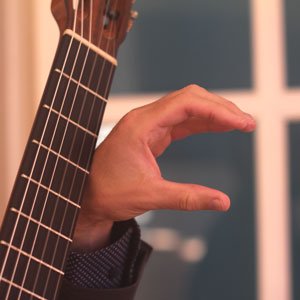
The neutral left-hand “C” shape
2. The left-hand C-shape
If you keep your thumb behind your fingers, you’ll enjoy the most strength and stretch. Keep the fingers curved as if making the letter C with the thumb and fingers.
3. Play just behind the fret
As a rule, the best place for the left-hand fingers is just behind the fret.
This presses the guitar string down with the least muscle. With this placement, we are less likely to buzz or mute the notes.
4. Keep a steady rhythm
We can use our scale practice to keep a steady rhythm in our playing. Keep it slow and consistent.
It may be tempting to play faster but then take more time at string crossings. Avoid this. Keep every note at an even speed.
This will help you to play music more beautifully in other parts of your practice. It will also encourage us to gently improve in more difficult areas without overwhelm or excess tension.
Play with the fingertip, not the pad
The pad of the finger is fleshy and pillowy. This means we need to use more effort to press down a string with the part of the finger.
Instead, use the tip of the finger. It is harder and can be more precise.
Also, we don’t want to buckle the small knuckle. Playing with the tip helps the finger stay curved and strong.
Scale Exercise: 1234s
For the next exercise, we can play all four fingers on each string. This is an extension of the Finger Walking.
Finger Walking is useful because it allows us to focus on fewer fingers at a time. We can use all our attention to improve those two fingers.
The 1234 exercise puts all four fingers into play, and increases the challenge.
The process is the same as Finger Walking. And all the tips above apply.
The Definition of Good Scale Practice
The main ingredient of a good scale practice is attention.
The patterns are repetitious, so we may be tempted to let our minds drift. But scales are a tool with which we get better. The point is to challenge ourselves and push our limits.
We can focus on finger placement, steady rhythm, and even volume and sound.
We can also notice how we use our bodies and muscles while playing our scales. If everything is feeling easy, we can speed up, which freshens all the challenges.
Most people who claim they don’t enjoy scales are missing this crucial point. Without the challenge, they’re not only boring, they don’t bring the benefits.
So the main point is to stay alert and aware while asking the fingers to do specific tasks. The work should be hard, but not so hard we tire or become discouraged.
And as we’ve said, we don’t need to overdo it. A few minutes of scales and exercises like this one in each practice will serve us for the long term.

Hi, I’m Allen Mathews.
I started as a folk guitarist, then fell in love with classical guitar in my 20’s. Despite a lot of practice and schooling, I still couldn’t get my music to flow well. I struggled with excess tension. My music sounded forced. And my hands and body were often sore. I got frustrated, and couldn’t see the way forward. Then, over the next decade, I studied with two other stellar teachers – one focused on the technical movements, and one on the musical (he was a concert pianist). In time, I came to discover a new set of formulas and movements. These brought new life and vitality to my practice. Now I help guitarists find more comfort and flow in their music, so they play more beautifully.
Click here for a sample formula.
I think the program levels are a great way to teach the guitar. I have had several teachers over the past few years and none came close to the structured organization that you have put together.
~ Peter Marior
-Peter Marior
Hi Allen, I am a Dutch guy who plays classical guitar (solo and together with a flute player). Unfortunately I have been suffering from focal dystonia since begin 2016. Of course I tried physical therapy which didn't help… But I tried some of your [technique] lessons (I had teachers before but I was never taught your techniques) and to my big surprise the nasty feeling in the back of my right hand which pulls my index finger upward was gone! So now I practice your lessons. Anyway, I am very happy to have found you on the internet. Thanks very much!
~ Arnoud Reinders
-Arnoud Reinders
“Success lies in relentless execution of the basics.”
Join the program that takes you from the beginning fundamentals to advanced mastery, so you…
- Move your hands safely and fluidly
- Enjoy fulfilling practices and meaningful work
- Play beautifully with expression and flow
Click the button to take a step towards an
organized, effective guitar practice. >>>