Robert Schumann’s Timeless Advice to Young Musicians
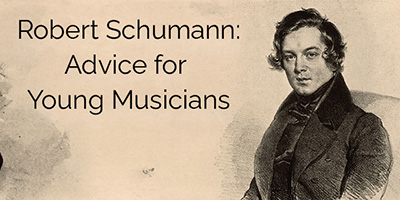
Robert Schumann (1810–1856) was one of the most influential composers of the Romantic era. He is known for his piano music, symphonies, chamber works, and Lieder (art songs).
Alongside his compositions, Schumann was a passionate teacher. He advocated for more music education in society. He was a gifted literary writer, mentoring widely through his essays, dialogues, poems, and letters.
To this end, he mentored young musicians and shared his thoughts on how to develop as an artist.
Advice to Young Musicians
Schumann’s Advice to Young Musicians is a collection of aphorisms he penned to guide aspiring musicians.
While we find “Young” in the title, these notes are applicable for any student of music at any age. And most are applicable to any instrument, including the guitar.
In his words, we find practical advice on technical matters. Perhaps more importantly, they reflect his belief that music is an art of emotional depth and intellectual engagement.
He said, “Music is to me the perfect expression of the soul.”
Schumann encourages young musicians to develop a well-rounded artistic personality. He suggests reading widely, listening to diverse music, and cultivating patience and dedication.
As you read through this collection, you’ll find timeless insights. These can resonate with musicians of any level, age, or instrument. Whatever your experience, Schumann’s advice will inspire you to deepen your connection to music.
Translation Notes
This translation by Henry Hugo Pierson was also completed in the 1860s. The language is at times dated, as we could expect.
Still, the messages ring true and provide a glimpse into the ethos of the Romantic Period. We can heed these words in our own study and the world of music will grow ever richer.
Top Advice for Classical Guitarists
The full list of Schumann’s advice totals 68 (below). Here are 8 that apply well to adults studying classical guitar.
There is much to gain from the full list. But this is a brief starting point.
1. “Endeavour to play easy pieces well and with elegance; that is better than to play difficult pieces badly.”
This advice is crucial for those who want to jump into advanced repertoire. Mastering simpler pieces with precision and musicality builds a strong foundation. This is more useful than tackling more complex works.
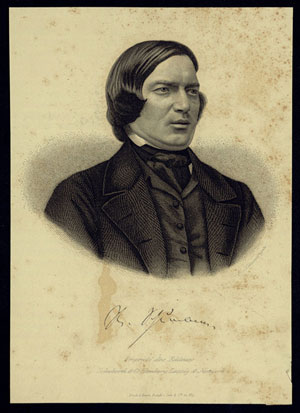
Composer Robert Schumann
2. “Never jingle! Play always with energy and do not leave a piece unfinished.”
This highlights the importance of discipline and focus. Adults often have limited time to practice. It helps to make each session intentional and to commit to completing pieces. (Not just the notes and rhythm, but the expression and emotion.). Even simple pieces build both skill and confidence.
3. “Do not think velocity, or passage-playing, your highest aim. Try to produce such an impression with a piece of music as was intended by the composer; all further exertions are caricatures.”
Speed and flash are nice. But classical guitar is an instrument that also demands expression and subtlety. Schumann’s advice here reminds us to focus on both technical skills and musical emotion.
4. “Take care always to have your instrument well tuned.”
Tuning is a fundamental skill for classical guitarists. Schumann’s advice to keep the guitar in tune is spot-on. After all, tuning can easily drift.
5. “With sweetmeats, pastry, and confectionary we cannot bring up children in sound health. The mental food must be as simple and nourishing as the bodily.”
This is relevant for guitarists choosing repertoire. Schumann advises focusing on quality over flashy or superficial music. Adult learners should avoid ambitious pieces before mastering the fundamentals. Instead, focus on pieces that provide solid technical and musical nourishment.
6. “As to choice in the study of your pieces, ask the advice of more experienced persons than yourself; by so doing, you will save much time.”
The fastest and most reliable way to choose appropriate pieces to play is to ask a qualified teacher. A seasoned player who knows the pedagogical repertoire can also help here.
7. “In judging of compositions, discriminate between works of real art and those merely calculated to amuse amateurs. Cherish those of the former description.”
Adults can sometimes be drawn to “easy arrangements” that don’t retain the musical integrity of the original composition. Schumann’s advice encourages us to focus on works that maintain artistic value. This is better, even if they are simpler.
8. “Practice music in company with others.”
Playing duets or participating in small ensembles can be particularly beneficial for adult learners. Classical guitar, with its rich tonal qualities, works beautifully in an ensemble setting. This can also build confidence and motivation.
9. “Let your intimate friends be chosen from such as are better informed than yourself.”
Adult guitarists can benefit from studying with a good teacher or program. And playing with more advanced musicians is also helpful. Surrounding oneself with knowledgeable players helps accelerate learning and provides valuable feedback.
The Full List of Robert Schumann’s Advice to Young Musicians
1. The cultivation of the Ear is of the greatest importance. — Endeavour early to distinguish each several tone and key. Find out the exact notes sounded by the bell, the glass, the cuckoo, etc.
2. Practise frequently the scale and other finger exercises; but this alone is not sufficient. There are many people who think to obtain grand results in this way, and who up to a mature age spend many hours daily in mechanical labour. That is about the same, as if we tried every day to pronounce the alphabet with greater volubility ! You can employ your time more usefully.
3. There are such things as mute pianoforte keyboards; try them for a while, and you will discover that they are useless. Dumb people cannot teach us to speak.
4. Play strictly in time! The playing of many a virtuoso resembles the walk of an intoxicated person. Do not take such as your model.
5. Learn the fundamental principles of Harmony.
6. Do not be afraid of the words Theory, Thoroughbass, Counterpoint, etc.; you will understand their full meaning in due time.
7. Never jingle! Play always with energy and do not leave a piece unfinished.
8. You may play too slow or too fast; both are faults.
9. Endeavour to play easy pieces well and with elegance; that is better than to play difficult pieces badly.
10. Take care always to have your instrument well tuned.
11. It is not only necessary that you should be able to play your pieces on the instrument, but you should also be able to hum the air without the piano. Strengthen your imagination so, that you may not only retain the melody of a composition, but even the harmony which belongs to it.
12. Endeavour, even with a poor voice, to sing at first sight without the aid of the instrument ; by these means your ear for music will constantly improve : but in case you are endowed with a good voice, do not hesitate a moment to cultivate it ; considering it at the same time as the most valuable gift which heaven has granted you!
13. You must be able to understand a piece of music upon paper.
14. When you play, never mind who listens to you.
15. Play always as if in the presence of a master.
16. If any one should place before you a composition to play at sight, read it over before you play it.
17. When you have done your musical day’s work and feel tired, do not exert yourself further. It is better to rest than to work without pleasure and vigour.
18. In maturer years play no fashionable trifles. Time is precious. We should need to live a hundred lives, only to become acquainted with all the good works that exist.
19. With sweetmeats, pastry and confectionary we cannot bring up children in sound health. The mental food must be as simple and nourishing as the bodily. Great composers have sufficiently provided for the former; keep to their works.
20. All bravura-music soon grows antiquated. Rapid execution is valuable only when used to perfect the performance of real music.
21. Never help to circulate bad compositions; on the contrary, help to suppress them with earnestness.
22. You should neither play bad compositions, nor, unless compelled, listen to them.
23. Do not think velocity, or passage-playing, your highest aim. Try to produce such an impression with a piece of music as was intended by the composer; all further exertions are carricatures.
24. Think it a vile habit to alter works of good composers, to omit parts of them, or to insert new-fashioned ornaments. This is the greatest insult you can offer to Art.
25. As to choice in the study of your pieces, ask the advice of more experienced persons than yourself; by so doing, you will save much time.
26. You must become acquainted by degrees with all the principal works of the more celebrated masters.
27. Do not be elated by the applause of the multitude; that of artists is of greater value.
28. All that is merely modish will soon go out of fashion, and if you practise it in age, you will appear a fop whom nobody esteems.
29. Much playing in society is more injurious than useful. Suit the taste and capacity of your audience; but never play anything which you know is trashy and worthless.
30. Do not miss an opportunity of practising music in company with others; as for example in Duets, Trios, etc.; this gives you a flowing and elevated style of playing, and self-possession. — Frequently accompany singers.
31. If all would play first violin, we could not obtain an orchestra. Therefore esteem every musician in his place.
32. Love your peculiar instrument, but be not vain enough to consider it the greatest and only one. Remember that there are others as fine as yours. Remember also that singers exist, and -that numbers, both in Chorus and Orchestra, produce the most sublime music; therefore do not overrate any Solo.
33. As you grow up, become more intimate with scores (or partitions) than with virtuosi.
34. Frequently play the fugues of good masters, above all, those by J. Seb. Bach. Let his „ Well -tempered Harpsichord” be your daily bread. By these means you will certainly become a proficient.
35. Let your intimate friends be chosen from such as are better informed than yourself.
36. Relieve the severity of your musical studies by reading poetry. Take many a walk in the fields and woods!
37. From vocalists you may learn much, but do not believe all that they say.
38. Remember, there are more people in the world than yourself. Be modest! You have not yet invented nor thought anything which others have not thought or invented before. And should you really have done so, consider it a gift of heaven which you are to share with others.
39. You will be most readily cured of vanity or presumption by studying the history of ’music, and by hearing the masterpieces which have been produced at different periods.
40. A very valuable book you will find that: On Purity in Music, by Thibaut, a German Professor.[*out of print] Read it often, when you have come to years of greater maturity.
41. If you pass a church and hear an organ, go in and listen. If allowed to sit on the organ bench, try your inexperienced fingers and marvel at the supreme power of music.
42. Do not miss an opportunity of practising on the organ; for there is no instrument that can so effectually correct errors or impurity of style and touch as that.
43. Frequently sing in choruses, especially the middle parts, this will help to make you a real musician.
44. What is it to be musical? You will not be so, if your eyes are fixed on the notes with anxiety and you play your piece laboriously through; you will not be so, if (supposing that somebody should turn over two pages at once) you stop short and cannot proceed. But you will be so if you can almost foresee in a new piece what is to follow, or remember it in an old one , — in a word, if you have not only music in your fingers, but also in your head and heart.
45. But how do we become musical? This, my young friend, is a gift from above; it consists chiefly of a fine ear and quick conception. And these gifts may be cultivated and enhanced. You will not become musical by confining yourself to your room and to mere mechanical studies, but by an extensive intercourse with the musical world, especially with the Chorus and the Orchestra.
46. Become in early years well informed as to the extent of the human voice in its four modifications. Attend to it especially in the Chorus, examine in what tones its highest power lies, in what others it can be employed to affect the soft and tender passions.
47. Pay attention to national airs and songs of the people ; they contain a vast assemblage of the finest melodies, and open to you a glimpse of the character of the different nations.
48. Fail not to practise the reading of old clefs, otherwise many treasures of past times will remain a closed fountain to you.
49. Attend early to the tone and character of the various instruments; try to impress their peculiar sound on your ear.
50. Do not neglect to attend good Operas.
51. Highly esteem the Old, but take also a warm interest in the New. Be not prejudiced against names unknown to you.
52. Do not judge a composition from the first time of hearing; that which pleases you at the first moment, is not always the best. Masters need to be studied. Many things will not become clear to you till you have reached a more advanced age.
53. In judging of compositions, discriminate between works of real art and those merely calculated to amuse amateurs. Cherish those of the former description, and do not get angry with the others.
54. Melody is the battle-cry of amateurs, and certainly music without melody is nothing. Understand, however, what these persons mean by it: a simple, flowing and pleasing rhythmical tune ; this is enough to satisfy them. There are, however, others of a different sort, and whenever you open Bach, Mozart, Beethoven, or any real master, their melodies meet you in a thousand different shapes. I trust you will soon be tired of the inferior melodies, especially those out of the new italian operas ; and of all vulgar ones.
55. If, while at the piano, you attempt to form little melodies, that is very well; but if they come into your mind of themselves, when you are not practising, you may be still more pleased; for the internal organ of music is then roused in you. The fingers must do what the head desires; not the contrary.
56. If you begin to compose, work it out in your head. Do not try a piece on your instrument, except when you have fully conceived it. If your music came from your heart and soul, and did you feel it yourself, — it will operate on others in the same manner.
57. If Heaven has bestowed on you a fine imagination, you will often be seated at your piano in solitary hours, as if attached to it; you will desire to express the feelings of your heart in harmony. And the more clouded the sphere of harmony may perhaps be to you, the more mysteriously you will feel’ as if drawn into magic circles. In youth these may be your happiest hours. Beware, however, of abandoning yourself too often to the influence of a talent that induces you to lavish powers and time, as it were, upon phantoms. Mastery over the forms of composition and a clear expression of your ideas can only be attained by constant writing. Write, therefore, more than you improvise.
58. Acquire an early knowledge of the art of conducting music. Observe often the best conductors, and conduct along with them in your mind. This will give you clearness of perception and make you accurate.
59. Look deeply into life, and study it as diligently as the other arts and sciences.
60. The laws of morals are those of art.
61. By means of industry and perseverance, you will rise higher and higher.
62. From a pound of iron, that costs little, a thousand watch-springs can be made, whose value becomes prodigious. The pound you have received from the Lord, — use it faithfully.
63. Without enthusiasm, nothing great can be effected in art.
64. The object of art is not to produce riches. Become a great artist, and all other desirable accessories will fall to your lot.
65. The Spirit will not become clear to you, before you understand the Forms of composition.
66. Perhaps genius alone understands genius fully.
67. It has been thought that a perfect musician must be able to see, in his mind’s eye, any new, and even complicated, piece of orchestral music as if in full score lying before him! This is indeed the greatest triumph of musical intellect that can be imagined.
68. There is no end of learning.
Image attribution:
Archivio Storico Ricordi, CC BY-SA 4.0 <https://creativecommons.org/licenses/by-sa/4.0>, via Wikimedia Commons
Unukorno, CC BY-SA 3.0 <https://creativecommons.org/licenses/by-sa/3.0>, via Wikimedia Commons
Hi, I’m Allen Mathews.
I started as a folk guitarist, then fell in love with classical guitar in my 20’s. Despite a lot of practice and schooling, I still couldn’t get my music to flow well. I struggled with excess tension. My music sounded forced. And my hands and body were often sore. I got frustrated, and couldn’t see the way forward. Then, over the next decade, I studied with two other stellar teachers – one focused on the technical movements, and one on the musical (he was a concert pianist). In time, I came to discover a new set of formulas and movements. These brought new life and vitality to my practice. Now I help guitarists find more comfort and flow in their music, so they play more beautifully.
Click here for a sample formula.
Hi Allen,
Greetings from the UK. I would like to thank you for providing such an excellent resource. The effort and skill which has gone into creating this program is very evident. I started classical guitar a year or so ago with a teacher but was unable to commit to same time regular slots each week.The Woodshed Program was exactly what I was looking for. I have found the site very intuitive and well structured and have taken your advice and started from the very beginning of the program whilst still practising some of the pieces I was already working on. It is clear that I will benefit greatly from these early technical studies. There were clearly weaknesses and gaps in my knowledge even though I am still at an early stage. Once again many thanks for the program and very best wishes.
~ Rodger Paylor
-Rodger Paylor
I appreciate the organized, well thought out progression of each level, as well as a measurable means to determine when to proceed to the next level. I had burned myself out by pushing too hard and playing beyond where I was comfortable. This course is just what I needed, and I am happy to be back on the road to playing again.
~ Susan Kidney
-
“Success lies in relentless execution of the basics.”
Join the program that takes you from the beginning fundamentals to advanced mastery, so you…
- Move your hands safely and fluidly
- Enjoy fulfilling practices and meaningful work
- Play beautifully with expression and flow
Click the button to take a step towards an
organized, effective guitar practice. >>>