How to Play Pizzicato Technique on Classical Guitar (pizz.)
The guitar is a versatile instrument. This is one reason Ludwig van Beethoven called the guitar “a miniature orchestra in itself.”
Using special techniques, we can create varied sounds and textures. And one such special techniques on guitar is the “pizzicato”.
What is Pizzicato (pizz.)?
“Pizzicato” translates roughly as “plucked”, or “pinched”. The result is a short, slightly muted sound, much like a jazz “walking bass”.
Instruments using a bow (violin, cello, etc.) may use the end of their bow to pluck the strings for this effect.
On guitar, we usually opt for the thumb.
When we see music that calls for pizzicato playing, it’s usually abbreviated “pizz.”.

How to Play Pizzicato on Classical Guitar – Right Hand Position
To play pizzicato on the guitar, first place the outside of the hand on the bridge of the guitar (as in a “karate chop”).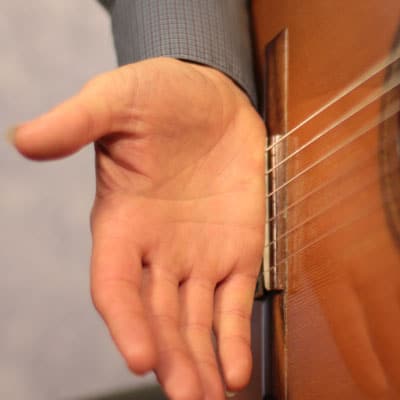
Next, roll the hand down toward the strings until the thumb comes within striking distance of the strings.
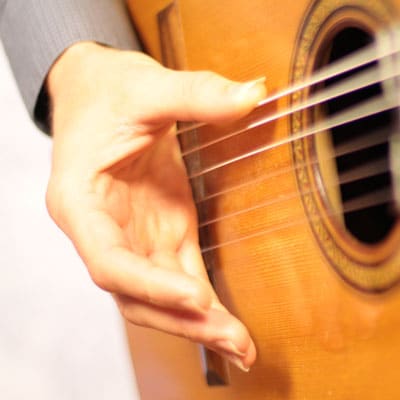
When we play from this position, the flesh of the outer hand is muting the strings back by the bridge, though not completely.
Usually Bass Guitar Strings Only on the Pizzicato
Most often, we only play pizzicato on guitar using the bass notes and strings.
While there are exceptions, the vast majority of pizzicato effects written in guitar music use the bass only.
This may be because of the lesser sound quality and projection of the higher-pitched pizzicato notes, or for ease of playing.
Listen for the Balance of Pitch and Duration
Through trial and error, we can find the perfect balance of pitch and duration.
If we mute the string too much, the note will come out as a “thud” or a “thunk”, and we won’t be able to hear the actual note.
If we mute too little, the note will ring out as normal.
Between these two is a “sweet spot” where the note is still audible, but is shortened and altered in tone quality.
Practice Moving Into and Out of Pizzicato Position
To gain facility with the pizzicato technique, we can practice moving into and out of position.
We can use any simple exercise or excerpt for this. The goal is to be able to jump into perfect pizzicato position, and return to an optimal basic position. We should be able to do this in rhythm and without much “foot shuffling”.
With a little time and practice, we can become masters of the pizzicato!

Hi, I’m Allen Mathews.
I started as a folk guitarist, then fell in love with classical guitar in my 20’s. Despite a lot of practice and schooling, I still couldn’t get my music to flow well. I struggled with excess tension. My music sounded forced. And my hands and body were often sore. I got frustrated, and couldn’t see the way forward. Then, over the next decade, I studied with two other stellar teachers – one focused on the technical movements, and one on the musical (he was a concert pianist). In time, I came to discover a new set of formulas and movements. These brought new life and vitality to my practice. Now I help guitarists find more comfort and flow in their music, so they play more beautifully.
Click here for a sample formula.
This is the ideal starting position for me. As a relative beginner with no teacher this is helping me enormously in developing good technique and not falling into bad habits. I no longer feel (A) That it's a struggle to learn a new piece and (B) That I am alone in my endeavors. My advice is to try The Woodshed program. It is fantastic and will not only bring up your playing but his explanations of musical concepts as you go along put things into perspective.
~ John Andersson
-John Andersson
I have to say after over 12 months of one-on-one training with a teacher before joining The Woodshed, this is the first time that I feel I’m making technical progress.
~ Nusret Aydemir
-Nusret Aydemir
“Success lies in relentless execution of the basics.”
Join the program that takes you from the beginning fundamentals to advanced mastery, so you…
- Move your hands safely and fluidly
- Enjoy fulfilling practices and meaningful work
- Play beautifully with expression and flow
Click the button to take a step towards an
organized, effective guitar practice. >>>