The Dangers of Speed in Classical Guitar Practice
Speed – playing guitar fast – can be helpful, or disastrous. It can be friend or foe. It’s all in how we use it.
So how do we know when to play fast and when to slow down? What’s wrong with playing at top speed all the time? Won’t that make us better and faster overall?
Speed is Wonderful – Fast is Fun
To be clear, it’s fun to play fast. It feels good. It’s an accomplishment and signifies a level of ability.
Speed is not an enemy. Instead, speed is a tool. It’s a musical tool that composers may use to communicate musical ideas. And it’s a technical tool to develop and test our abilities. More on this later.
In this way, we can think of speed like tone quality, legato, staccato, loud or soft (dynamics). It’s one of many tools in our musical tool chest.
But like any tool, it can be misused…
Speed Creates the Illusion of Perfection
When we play fast, we tend to perceive a higher level of accuracy. In reality, we miss more notes. We buzz and squeak and thud.
The notes go by so quickly that we don’t hear what is happening. Instead, we “hear” what we know we would like to hear. We fool ourselves. (Recording for practice is a wonderful way to stay honest.)
When we play fast, we have the illusion that everything is perfect. We assume we are doing better than we actually are.
Plus, we miss many of the signs that could clue us into larger issues, such as excess tension or poor form and positioning. These can lead to tendonitis, focal dystonia, or generalized pain and discomfort.
Speed Can Be a Distraction
When our main goal is speed, we tend to ignore other elements of the music.
Musical phrasing consists of volume level, rhythmic placement, tone, and other things. If we only focus on speed, we may miss these. And from these spring much of the musical expression and emotion.
If we only focus on speed, we fail to ask other questions. Our musical worlds stay small, and our feelings of success are tied to only one metric.
Guitar Speed is a Limited Metric for Evaluation
Speed is a worthwhile goal. When we can play cleanly at high speeds it means we have ingrained certain movements and can perform them at that level. This allows us to play a wider variety of music, and with a wider variety of tempo (the musical word for speed).
So we can use speed as a benchmark of ability. But not all ability – just a narrow slice of technical ability.
But as said above, an ability to play fast doesn’t mean we play beautifully. It takes more than speed for that.
How to Use Speed in Classical Guitar Practice
So how to we use speed to benefit, while avoiding the pitfalls?
Speed is a worthwhile goal in technique practice. But only so long as we also train cleanliness (accuracy and consistency).
Practicing pieces, speed is better left for the very latter part of the polishing process. Instead, when we focus on clarity and musical intention, we play more beautifully.
Most of playing music is mental. We have to know and demonstrate the fine details of every note and phrase. When we have embodied these, speed is usually an easy addition (in comparison). This is true so long as we can play at the needed tempo, based on our technique practice.
There may be tricky spots that need more work. But most of the time, if we develop the clarity of intention for each note, speed comes easily afterwards.
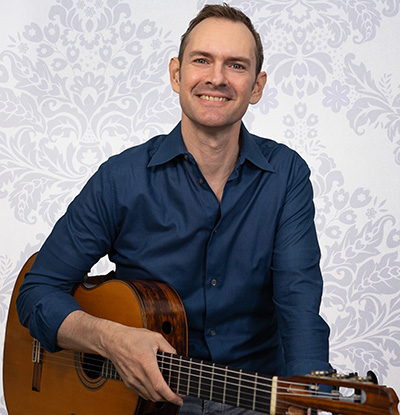
Hi, I’m Allen Mathews.
I started as a folk guitarist, then fell in love with classical guitar in my 20’s. Despite a lot of practice and schooling, I still couldn’t get my music to flow well. I struggled with excess tension. My music sounded forced. And my hands and body were often sore. I got frustrated, and couldn’t see the way forward. Then, over the next decade, I studied with two other stellar teachers – one focused on the technical movements, and one on the musical (he was a concert pianist). In time, I came to discover a new set of formulas and movements. These brought new life and vitality to my practice. Now I help guitarists find more comfort and flow in their music, so they play more beautifully.
Click here for a sample formula.
I have to say after over 12 months of one-on-one training with a teacher before joining The Woodshed, this is the first time that I feel I’m making technical progress.
~ Nusret Aydemir
-Nusret Aydemir
Hi Allen,
Greetings from the UK. I would like to thank you for providing such an excellent resource. The effort and skill which has gone into creating this program is very evident. I started classical guitar a year or so ago with a teacher but was unable to commit to same time regular slots each week.The Woodshed Program was exactly what I was looking for. I have found the site very intuitive and well structured and have taken your advice and started from the very beginning of the program whilst still practising some of the pieces I was already working on. It is clear that I will benefit greatly from these early technical studies. There were clearly weaknesses and gaps in my knowledge even though I am still at an early stage. Once again many thanks for the program and very best wishes.
~ Rodger Paylor
-Rodger Paylor
“Success lies in relentless execution of the basics.”
Join the program that takes you from the beginning fundamentals to advanced mastery, so you…
- Move your hands safely and fluidly
- Enjoy fulfilling practices and meaningful work
- Play beautifully with expression and flow
Click the button to take a step towards an
organized, effective guitar practice. >>>