John W. Gardner on Creativity and Musical Creation
Tuesday Quotes are short explorations of music, life, and the daily endeavor of practicing classical guitar. Find more here. Enjoy!
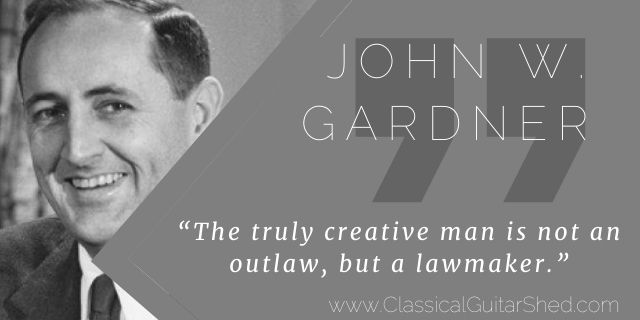
“The truly creative man is not an outlaw, but a lawmaker.”
John W. Gardner
In his excellent 1963 book Self-Renewal, former Secretary of Health John W. Gardner discusses creativity and the self-renewal process.
He suggested that creativity is more about order than chaos. This moves contrary to the beatnik philosophy of his day. He noted that creative people organize thoughts and the world in new and novel ways.
He also observed that many of the most creative people bring order and predictability in other parts of their lives. This allows them to spend their creative energies on their area of focus.
A “creative restraint” is a set of rules or boundaries that limit the number of wildcards in a pursuit. These limitations create more freedom than they remove. And with strategic boundaries, we’re able to direct our energy where we choose.
In an ongoing classical guitar practice, we also create these boundaries. We use creative restraints as a daily tool. This allows us the flexibility to explore deeper, rather than wider.
As creative restraints, we start with a composed piece of music. The notes are set on paper. We may also be given the fingerings and some expressive suggestions.
The act of playing a composed piece of music is a creative act. It is a partnership between composer and player. We, the players, are faced with the challenge of bringing to life that which the composer has outlined. And to meet this challenge we use many creative faculties.
We solve technical problems. We troubleshoot and root out stumbling blocks. We play our bodies as much as we do the guitar.
A piece of music is a structured container in which we may play and experiment. In doing so, we add our own laws and rules to those given us. We tighten the parameters on all sides through decisions and choices (techniques and movements used, volume, sound quality, etc.).
And having removed one variable we can then focus on the next. Then the next. As we slice away the unknown we reveal more subtle demands and opportunities for artistry.
Through this process, we are invited to ask new questions and explore new possibilities. Like levels of a game, we graduate to new inquiries and challenges. Or as Tom Sachs said, “The reward for good work is more work.”

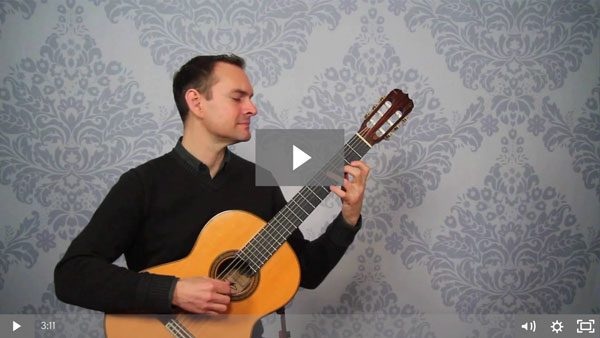
Hi, I’m Allen Mathews.
I started as a folk guitarist, then fell in love with classical guitar in my 20’s. Despite a lot of practice and schooling, I still couldn’t get my music to flow well. I struggled with excess tension. My music sounded forced. And my hands and body were often sore. I got frustrated, and couldn’t see the way forward. Then, over the next decade, I studied with two other stellar teachers – one focused on the technical movements, and one on the musical (he was a concert pianist). In time, I came to discover a new set of formulas and movements. These brought new life and vitality to my practice. Now I help guitarists find more comfort and flow in their music, so they play more beautifully.
Click here for a sample formula.
Hello Allen,
I feel my guitar proficiency is improving considerably. Every day I’m exceedingly comfortable with my right hand technique and overall fluency. And my sight-reading has improved as well. Thank you for creating the Woodshed. It’s thoughtful construction and scope and sequence of knowledge and skills has advanced my guitar skills significantly. I can’t wait to see what the future holds.
~ Michael Immel
-Michael Immel
Your GCS site and The Woodshed community are really super! I am glad I finally joined in, and smacking myself for waiting so long. Thanks again!
~ Carol Morin
-Carol Morin
“Success lies in relentless execution of the basics.”
Join the program that takes you from the beginning fundamentals to advanced mastery, so you…
- Move your hands safely and fluidly
- Enjoy fulfilling practices and meaningful work
- Play beautifully with expression and flow
Click the button to take a step towards an
organized, effective guitar practice. >>>