Rory Sutherland on Questioning Everything and Being Slightly Silly
Tuesday Quotes are short explorations of music, life, and the daily endeavor of practicing classical guitar. Find more here. Enjoy!
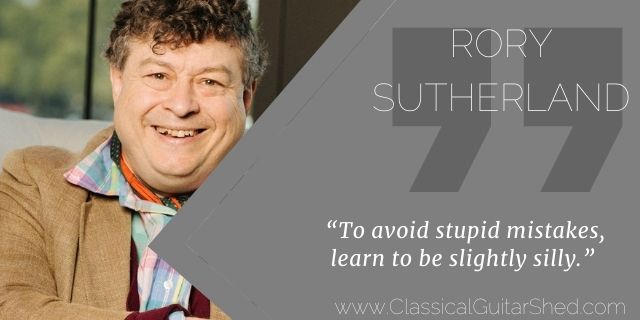
“To avoid stupid mistakes, learn to be slightly silly.”
Rory Sutherland
The jester was valued at the courts of old because he could say what others could not.
He could be silly and state the obvious that no one else allowed themselves to see. The jester, ostensibly there for entertainment, was in fact a trusted advisor. He offered a different perspective.
As we gain skill and experience on the guitar, we face grave danger. We face a trap into which many are lost.
This is the trap of arrogance. When we succumb, we wall ourselves off from many of the resources that helped us learn in the first place.
In the grip of our role as “an intermediate guitarist” or “a long-time musician,” we may become close-minded. We may get set in our ways, even if those ways do not work.
Instead of calcifying into a musician who makes little progress despite ongoing work, we can learn to explore anew.
Ad-man Rory Sutherland, in his insightful book, Alchemy, suggests, “to avoid stupid mistakes, learn to be slightly silly.”
On guitar, being slightly silly can mean going back to the basics. We can step down from our self-built pedestals and survey the ground levels once again.
To avoid dead ends and glass ceilings, we can question each element of our movements and approach. We can experiment with new ways of learning pieces.
We can look for new perspectives on the exercises, scales, and right-hand patterns we may have known for years.
Throughout life and throughout the ages, we have been betrayed by our assumptions. We may believe in earnest that which just isn’t so. And the consequences mount as we continue to work under these false assumptions.
Better to put aside our crowns and titles and allow a gentle skepticism of all we hold true. There may yet be a smoother path through the hills.
And change can be easier and quicker than we may imagine. Our previous work has not been in vain. Every moment of practice can add to our flexibility, making us more versatile. We can relish every blunder discovered, grateful for the course correction.
We can still work from experience, with “strong opinions, loosely held.” We can act in faith of our technique and approach while also seeking better. We can keep the jester in court.

Hi, I’m Allen Mathews.
I started as a folk guitarist, then fell in love with classical guitar in my 20’s. Despite a lot of practice and schooling, I still couldn’t get my music to flow well. I struggled with excess tension. My music sounded forced. And my hands and body were often sore. I got frustrated, and couldn’t see the way forward. Then, over the next decade, I studied with two other stellar teachers – one focused on the technical movements, and one on the musical (he was a concert pianist). In time, I came to discover a new set of formulas and movements. These brought new life and vitality to my practice. Now I help guitarists find more comfort and flow in their music, so they play more beautifully.
Click here for a sample formula.
Great advise here. I find I am taking more time with the pieces than I would have in the past as I am focusing on the technique you have taught me. It is slower going at first but has fewer frustrations, is easier and sounds better in the end.
~ Karen Richardson
-Karen Richardson
Thanks to you (you are my only teacher) in only a few months I've gone from very basic beginner pieces to having just completed learning Bach's Gavottes 1&2 in good form and execution. As a non-classical electric guitarist who has always used a pick and never his fingers, this has been no small feat!
~ Gregg Olson
-Gregg Olson
“Success lies in relentless execution of the basics.”
Join the program that takes you from the beginning fundamentals to advanced mastery, so you…
- Move your hands safely and fluidly
- Enjoy fulfilling practices and meaningful work
- Play beautifully with expression and flow
Click the button to take a step towards an
organized, effective guitar practice. >>>