
F.M. Alexander on Tension and Freedom in Guitar-Playing
Tuesday Quotes are short explorations of music, life, and the daily endeavor of practicing classical guitar. Find more here. Enjoy!
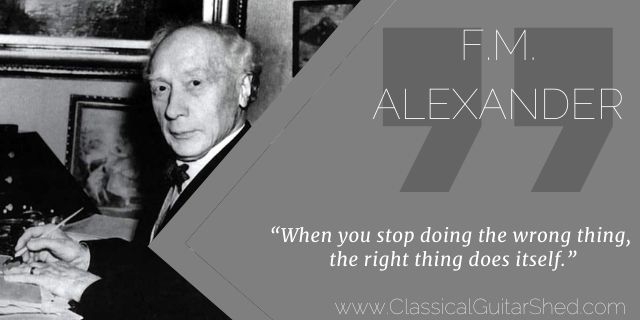
“When you stop doing the wrong thing, the right thing does itself.”
F.M. Alexander
Frederick Matthias Alexander created a work whereby he could break free from habitual patterns of tension. We all have these patterns. Some are constructive, others are not.
The Alexander Technique is a practice whereby students can inhibit automatic muscle contractions. It’s widely used by actors, musicians, and people with chronic pain.
His idea was that if you stop all the non-desirable tension patterns, the best use of the self could emerge. This means that we can do any action with the least effort needed.
This is the implication of the quote, “When you stop doing the wrong thing, the right thing does itself.” If we don’t go wrong, we’ll go right.
This is not a universal truth. In many areas, we can topple one bad element only to have it replaced by one worse. We may not be aware of all the forces at play. And changing just one element in an ecosystem can cause an imbalance in which new problems can arise.
Alexander counters this by focusing on the prime directive: freedom in all joints, appropriate tension for the task at hand, and a general sense of “up.”
A common mistake beginning guitarists make is to assume that what feels “natural” is the best way. It rarely is.
That is because these feelings are only based on previous comfort (homeostasis). Much of playing classical guitar well is counter-intuitive.
So we must avoid what we know to be wrong while allowing for new possibilities. Meanwhile, we continue to discover, through teachers and experience, what to avoid.
Viktor Frankl also spoke to this in more general terms: “Between stimulus and response, there is a space. In that space is our power to choose our response. In our response lies our growth and our freedom.“
Avoiding the wrong gives space for something different and new. This can feel strange because it is not our usual way of doing.
If we continue to inhibit (prevent) excess tension while keeping the prime directive in mind, we can play with more ease, fluidity, and awareness.

Hi, I’m Allen Mathews.
I started as a folk guitarist, then fell in love with classical guitar in my 20’s. Despite a lot of practice and schooling, I still couldn’t get my music to flow well. I struggled with excess tension. My music sounded forced. And my hands and body were often sore. I got frustrated, and couldn’t see the way forward. Then, over the next decade, I studied with two other stellar teachers – one focused on the technical movements, and one on the musical (he was a concert pianist). In time, I came to discover a new set of formulas and movements. These brought new life and vitality to my practice. Now I help guitarists find more comfort and flow in their music, so they play more beautifully.
Click here for a sample formula.
I practiced your system for three days, and it solved the I-M alternation problem I had been struggling with since I undertook classical guitar three years ago. Many thanks!
~ Johnny Geudel
-Johnny Geudel
For the first time ever, I have achieved great tone on my acoustic guitars. I've been studying fingerstyle guitar and music theory for about one year now. Tonight is the first time, I feel quite satisfied with my ability to produce a nice clear tone when striking the strings with my right hand fingers. By following your training videos in the program, I'm gradually developing my fingerstyle playing ability. KUDOS to you, Allen Mathews.
~ Joaquin Kenyon
-Joaquin Kenyon
“Success lies in relentless execution of the basics.”
Join the program that takes you from the beginning fundamentals to advanced mastery, so you…

- Move your hands safely and fluidly
- Enjoy fulfilling practices and meaningful work
- Play beautifully with expression and flow
Click the button to take a step towards an
organized, effective guitar practice. >>>