
Guitar Tremolo Exercise: Use Accents for Smoother Tremolo
Classical guitar tremolo is a beautiful and lyrical technique. It can offer contrast and variety to any set of music. And it makes us look like virtuosos!
But tremolo can be tricky. The rhythm can lilt and gallop. The volume of the notes can be uneven. We can hit the wrong string. And the list goes on.
Here’s an exercise we can use to smooth out our tremolo, and play more flowing, accurate and precise tremolo.
Classical Guitar Tremolo Technique
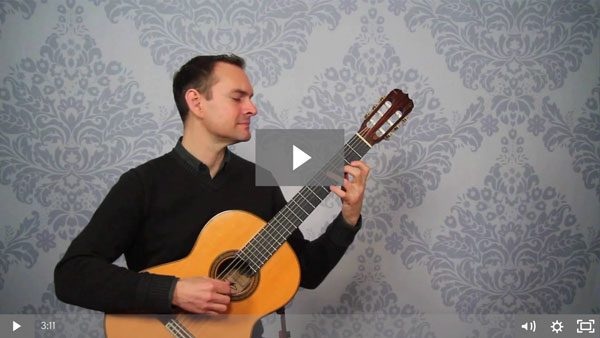
Taking a step back, it helps to practice tremolo with a specific technique in mind, such as the one in the video below. When we carefully consider our PAMI movements, we’re more likely to avoid injury. And we’re also more likely achieve our desired tone quality.
Click here for a free course on classical guitar tremolo technique.
Tremolo Accent Exercises
We can use accents to gain control and consistency in our tremolo. In this exercise, we accent each note of the pattern in turn.
The key to effective accents is to both play the accented note louder, and also play the unaccented notes quieter. This creates more contrast between accented and unaccented notes.
TIP: The note just after the accented note is the “Danger Note”. The tension from playing the accent will want to carry over to the next note. By keeping the pace slow, we can continue to hear each note. This will allow us to create a large contrast in volume between the accent and the note just after.
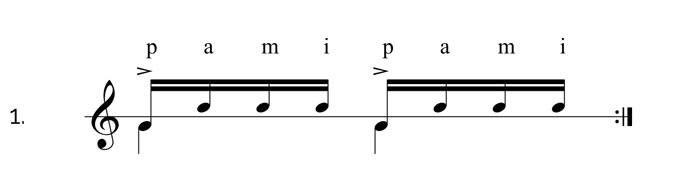
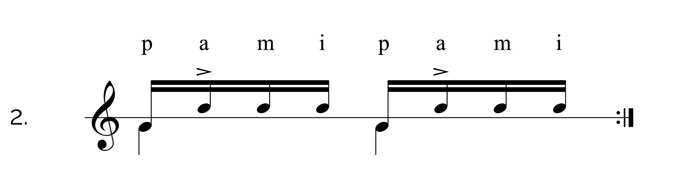
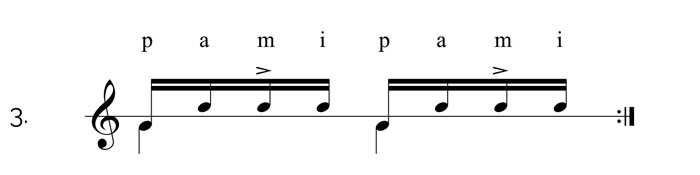
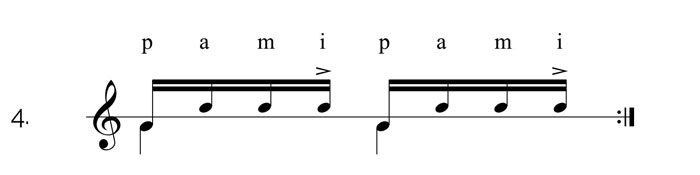
Practice Tremolo in Short Bursts
As a general rule, it’s safest to practice tremolo in short bursts, instead of for long durations. Keeping practices short will encourage us to keep focused and aware. It will also reduce the chance of repetitive stress injuries.
Guitar tremolo is a long-term project. This is a technique we practice on an ongoing basis for years. So slow practice and short-duration practice are effective strategies to develop a smooth, consistent and beautiful tremolo.

Hi, I’m Allen Mathews.
I started as a folk guitarist, then fell in love with classical guitar in my 20’s. Despite a lot of practice and schooling, I still couldn’t get my music to flow well. I struggled with excess tension. My music sounded forced. And my hands and body were often sore. I got frustrated, and couldn’t see the way forward. Then, over the next decade, I studied with two other stellar teachers – one focused on the technical movements, and one on the musical (he was a concert pianist). In time, I came to discover a new set of formulas and movements. These brought new life and vitality to my practice. Now I help guitarists find more comfort and flow in their music, so they play more beautifully.
Click here for a sample formula.
I have to say, two practices later [after a video review] with the new position - the difference it's made in my playing is... unbelievable, really. It's like many months of improvement overnight.
Everything is so much more secure, left-hand stretches are easier, I feel like I'm getting way more volume for the same effort, the tone is noticeably better all along the neck, and the list goes on.
Thank you!
~ Alexander Mosolov
-
Hi Allen, I am thoroughly enjoying your website and I find it is just what I need in my renewed passion for classical guitar. I have rediscovered a great love for this instrument and the music I can learn and play and it has changed my life for the better dramatically! Thank you for facilitating this process.~
~ George Rogers
-George Rogers
“Success lies in relentless execution of the basics.”
Join the program that takes you from the beginning fundamentals to advanced mastery, so you…
- Move your hands safely and fluidly
- Enjoy fulfilling practices and meaningful work
- Play beautifully with expression and flow
Click the button to take a step towards an
organized, effective guitar practice. >>>