Speed and Precision Exercises for Classical Guitar
Whether we’re practicing scales, exercises, or a piece of music, it helps to have well-synchronized hands.
When our hands work well together, we can play more beautifully, and create more flowing melodies.
And to develop solid timing between the hands, we can use specialized exercises.
Precision and Speed Exercises for Classical Guitar
We can use “chromatic speed bursts” to build speed and agility.
For this exercise, we begin using four adjacent frets on one string, played with left-hand fingers 1,2,3, and 4.
In the right hand, use quick-prepping with I and M alternation (index and middle fingers alternating back and forth). Quick-prepping combines the playing of one note with the preparation for the next.
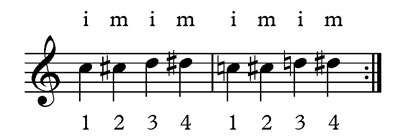
Begin with steady, evenly spaced notes, focusing on synchronizing the hands.
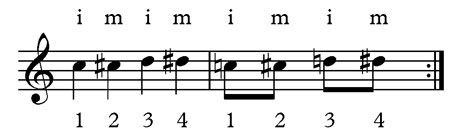
Next, alternate between slow steady notes, and bursts of the pattern at double-speed.
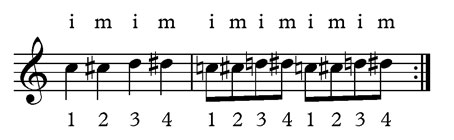
When you’re ready, increase the length of the fast bursts.
As you become better at these exercises, you can add to the exercises for more challenge. You can practice moving between strings. You can increase the speed using a metronome. And you can increase the duration of the workout by moving up and down the guitar neck.
Enjoy this simple exercise in your daily practice, or bring it out when needed.
And like any classical guitar practice, these work best when we bring absolute focus and attention to each note. The more precisely and accurately we play each note, the more benefit we’ll notice in our pieces and other technique practice.
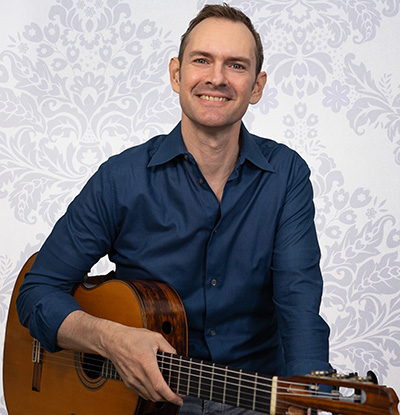
Hi, I’m Allen Mathews.
I started as a folk guitarist, then fell in love with classical guitar in my 20’s. Despite a lot of practice and schooling, I still couldn’t get my music to flow well. I struggled with excess tension. My music sounded forced. And my hands and body were often sore. I got frustrated, and couldn’t see the way forward. Then, over the next decade, I studied with two other stellar teachers – one focused on the technical movements, and one on the musical (he was a concert pianist). In time, I came to discover a new set of formulas and movements. These brought new life and vitality to my practice. Now I help guitarists find more comfort and flow in their music, so they play more beautifully.
Click here for a sample formula.
I also want to thank you for including more video lessons on the Bridges Guitar Series. I have learned to play Calatayud's Waltz. The most exciting thing about having done this is that I sight-read the entire piece as I was learning it. Six months ago looking at a sheet of music was like looking at Egyptian hieroglyphics. Learning to read notation is empowering and I appreciate the sensible way you are teaching us to learn to read music.
~ Steve Simpler
-Steve Simpler
Allen, your website and teaching methods are excellent. You have an easy going yet encouraging way of inspiring people to learn and practice their art. And you are always accessible to your students to personally answer questions. I appreciate ... that personal touch. The course on reading rhythm and playing higher up the neck I found particularly helpful. God bless you and many thanks.
~ Joe Bazan
-Joe Bazan
“Success lies in relentless execution of the basics.”
Join the program that takes you from the beginning fundamentals to advanced mastery, so you…
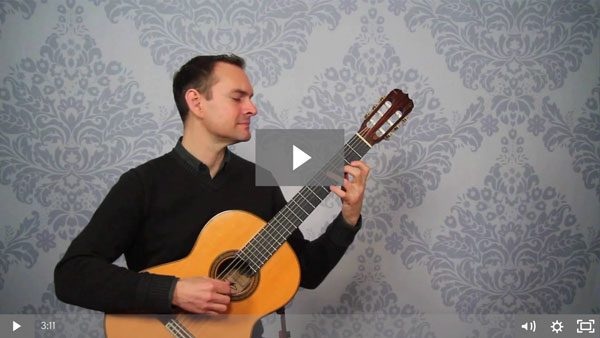
- Move your hands safely and fluidly
- Enjoy fulfilling practices and meaningful work
- Play beautifully with expression and flow
Click the button to take a step towards an
organized, effective guitar practice. >>>