What to Practice Next: How to Elevate Your Pieces
You’ve put in the hard work. You’ve learned the notes, memorized the fingerings, and can play through the music.
But now what? How do you elevate your playing from simply correct to truly musical?
In this article, we’ll explore three powerful practice strategies. These can take your guitar practice to the next level and breathe life into your music.
The Common Pitfall: Repetition Without Purpose
Many guitarists fall into a common practice trap. Here’s the scenario:
- Learn the notes.
- Play the piece through as many times as possible.
While repetition is important, mindless repetition won’t lead to improvement.
Others might declare the piece “finished” and move on to the next challenge.
But the truth is, once you’ve learned the notes, that’s when the real work of music-making begins.
What is Great Practice?
Ideally, each practice feels rewarding and satisfying. We feel like we’ve made progress.
Time disappears. We become completely engrossed in small, concrete challenges.
And we work at the edge of Hard, But Not Too Hard.
To practice this way, we must first find specific details on which to work. The more specific, the better.
And to find these specific details and challenges, we need:
- Our ears
- Our musical knowledge
- Our inner sense of what is beautiful and right (heart and gut)
Strategy 1: Slow Down and Listen Deeply
The first and perhaps most powerful strategy is to slow down and listen.
This method allows you to hear details that might escape you at full tempo. Here’s how to do it effectively:
First, set a slow, comfortable tempo
Play through the piece, focusing on:
- The volume of each note
- Tone quality
- Note placement and timing
- Any buzzes or unwanted sounds
- The connections between notes
- Pay special attention to:
- Melody prominence and beauty
- Rhythmic accuracy
- Phrasing and musical expression
By slowing down, you give yourself the mental bandwidth to truly hear what you’re playing. This process often reveals areas for improvement that you might miss at full speed.
Strategy 2: Video Yourself and Analyze
Recording yourself playing and reviewing it can be a transformative practice technique.
It allows you to step outside yourself. From there, you can observe your playing from an external perspective. Here’s what to look for:
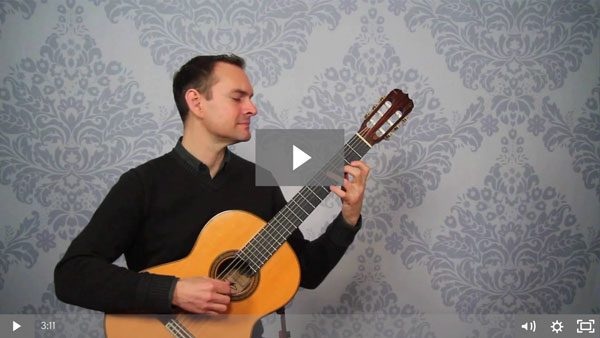
- Hand position and movement
- Body posture and tension
- Facial expressions
- Specific technical elements like:
- Shifts along the neck
- Thumb placement during shifts
- Overall hand angles
Don’t just focus on the visual aspects. Listen closely to the recording as well, paying attention to:
- Melody clarity
- Balance between different voices
- Dynamic changes (swells and fades)
- Overall tone quality
- Any sections where the sound quality changes unexpectedly
This strategy allows you to be your own teacher. You can identify areas for improvement that you might not notice while playing.
Strategy 3: Push Your Limits with Speed
Once you feel confident with your piece at a moderate tempo, it’s time to explore your limits.
This doesn’t mean always playing fast, but rather using speed as a diagnostic tool.
Here’s how:
First, gradually increase the tempo beyond your comfort zone.
Then notice where and how your playing breaks down.
- Identify the limiting factors:
- Is it a memory issue in certain sections?
- Does your technique falter at higher speeds?
- Are there specific transitions or shifts that become problematic?
- Are you able to maintain all the beautiful phrasing and expression?
By finding your breaking point, you can pinpoint exactly what needs work.
Remember, every player has a speed limit – the goal is to find yours and then work to expand it.
Bringing It All Together
These three strategies – slow practice, video analysis, and speed exploration – form a powerful toolkit for improving your classical guitar playing.
By adding them to your practice routine, you’ll find new areas for growth and refinement in your music.
Remember, the goal isn’t perfection, but rather continuous improvement and deeper musical expression. Enjoy the process of discovery and growth in your playing.
FAQ
Q: How often should I video record myself playing?
A: Try to record yourself at least once a week, or whenever you feel you’ve made significant progress on a piece.
Q: Is it normal to feel uncomfortable watching myself play on video?
A: Yes, it’s very common to feel self-conscious at first. With time, you’ll become more comfortable and objective in your self-analysis. The important part is that you (1) find specific areas to improve and (2) work on them in your next practice.
Q: How slow should I go when doing slow practice?
A: Slow enough that you can consciously focus on every single note. This might be half-speed or even slower for complex passages.
Q: Can these techniques be applied to exercises and etudes as well as pieces?
A: Absolutely! These strategies can improve all aspects of your playing, from technical exercises to performance pieces.
Q: How do I know when I’m ready to move on to a new piece?
A: Instead of thinking in terms of “finishing” a piece, consider setting specific musical goals. Once you’ve achieved those goals and can play the piece confidently and expressively, you’re ready to add new material to your practice routine.

Hi, I’m Allen Mathews.
I started as a folk guitarist, then fell in love with classical guitar in my 20’s. Despite a lot of practice and schooling, I still couldn’t get my music to flow well. I struggled with excess tension. My music sounded forced. And my hands and body were often sore. I got frustrated, and couldn’t see the way forward. Then, over the next decade, I studied with two other stellar teachers – one focused on the technical movements, and one on the musical (he was a concert pianist). In time, I came to discover a new set of formulas and movements. These brought new life and vitality to my practice. Now I help guitarists find more comfort and flow in their music, so they play more beautifully.
Click here for a sample formula.
I am truly enjoying the growth and challenge that the Woodshed material provides. I look forward to working hard and learning much in the years ahead. Thanks for all the effort and care that you have taken in providing these lessons and resources!
~ Mark Whitsett
-Mark Whitsett
Life is good, still enjoying [The Woodshed Program], the progress is life altering, I love it. The physical challenges of my situation have rained havoc for over half my life. In spite of those little pests this 40$ Yamaha classical who needed a new home and your course has given me the "part the clouds for the sun to shine through" outlook. You see, even when I am unable to play I know she patiently waits for my return as I do. A giant void in my journey was filled with light.
~ Ken Montz
-Ken Montz
“Success lies in relentless execution of the basics.”
Join the program that takes you from the beginning fundamentals to advanced mastery, so you…
- Move your hands safely and fluidly
- Enjoy fulfilling practices and meaningful work
- Play beautifully with expression and flow
Click the button to take a step towards an
organized, effective guitar practice. >>>