
Sight-Reading vs. Reading Music: What’s the Difference?
Do you know the difference between sight-reading and reading music? This article will show you what each skill involves and why it matters.
Sight-reading lets you play music the first time you see it. Reading music helps you understand and interpret written notes.
Mastering both skills can boost your practice and performance. Know your tools and play great music!
What Does it Mean To “Read” Music
Reading music is the ability to interpret written musical notation.
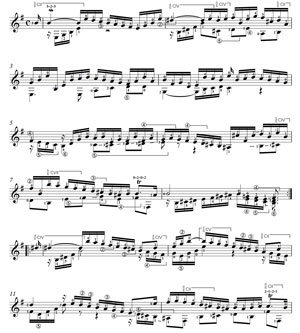
Musical Notation for Guitar
This involves understanding all the ink on the page. This includes the notes, rhythms, dynamics, and other symbols. Composers use these to convey their musical ideas. Our job is to hear what they are saying.
Reading music, we translate the written symbols into sound.
This process requires knowing some fundamental music theory and the technical skills to play the notes.
What is Sight-Reading Music on Guitar?
Sight-reading music is the ability to play or sing a piece of music for the first time. We read the sheet music without having seen it before.
It is a different skill from reading music in general. It involves real-time processing and execution of the musical notation.
Sight-reading requires quick recognition of notes, rhythms, and other musical elements. It also asks that we maintain a steady tempo and keep going even when we make mistakes.
Sight-Reading is a Separate Skill
Both reading music and sight-reading involve interpreting written music. But sight-reading is a more immediate and spontaneous activity. It demands a high level of focus and the ability to make quick decisions.
Those who sight-read well can quickly grasp the overall structure and flow of a piece. This makes it possible to perform it with minimal preparation.
We can develop this skill through regular practice. It also helps to get exposure to a wide variety of musical styles and notations.
The Main Goal of Sight-Reading
The main goal of sight-reading is to keep going. We want to capture the essence of the music and deliver a coherent performance, even if it is not perfect.
Sight-reading prioritizes continuity and musicality over precision.
The game is to keep going, maintain the tempo (speed), and convey the character of the music. This is more important than playing every note correctly.
Fingering is NOT Important for Sight-Reading
In sight-reading, the emphasis is on maintaining the flow of the music. It is not to use perfect fingerings or get all the technical details.
We may often use simplified or approximate fingerings to keep the performance going.
The goal is to give a plausible rendition of the piece. Hopefully, we can capture its main features and overall spirit.
Common Use Cases for Reading Music and Sight-Reading
Here are some common scenarios we often find in practice.
First Read of a New Piece
We can use sight-reading mode when encountering a new piece of music for the first time.
This initial play-through helps us get an overview. A sense of the piece’s structure, themes, and technical challenges. And it gives us a foundation for future guitar practice and refinement.
Learning a New Piece
When learning a new piece, sight-reading allows us to explore different sections quickly. We can then identify areas that need more focused practice.
It helps us develop an understanding of the piece before diving into detailed work.
Once we decide to learn the piece in earnest, we study the music more closely. Here, we are reading the music, but no longer sight-reading.
We pay extra attention to fingerings and expressive markings. We may analyze the harmony (chords) and the musical form.
Polishing a Piece of Music
Even after we’ve learned the piece, sight-reading skills can be useful. We’re more likely to be able to play it through in its entirety to ensure continuity and musical flow.
This can help us identify any remaining rough spots and smooth out our performance.
Playing New Music with Others
Sight-reading is crucial for rehearsing new music with other musicians.
It allows the group to play through the piece together and understand how the separate parts fit into the whole. Then each player can make adjustments as needed.
Good sight-reading skills contribute to more effective and efficient rehearsals. We can study more deeply at home, but continuity is more important at the rehearsal.
Improve Your Music Skills
So reading music and sight-reading music share some common elements. However, they are distinct skills with different goals and applications.
Reading music involves a deep understanding and interpretation of written notation. Sight-reading focuses on the ability to perform music on the first attempt.
Developing both skills is beneficial for well-rounded musicianship.
If you want to improve your sight-reading and the skills you use to learn and polish new pieces, consider The Woodshed® Classical Guitar Program.

Hi, I’m Allen Mathews.
I started as a folk guitarist, then fell in love with classical guitar in my 20’s. Despite a lot of practice and schooling, I still couldn’t get my music to flow well. I struggled with excess tension. My music sounded forced. And my hands and body were often sore. I got frustrated, and couldn’t see the way forward. Then, over the next decade, I studied with two other stellar teachers – one focused on the technical movements, and one on the musical (he was a concert pianist). In time, I came to discover a new set of formulas and movements. These brought new life and vitality to my practice. Now I help guitarists find more comfort and flow in their music, so they play more beautifully.
Click here for a sample formula.
I just started level 1C...I was able to look at a Carulli piece, albeit a simple one, and understand it. And that understanding allowed me to play it much more easily on the first run through, and I expect it will allow me to make it fully musical at tempo quite soon. That's a huge personal victory for me. Until very recently my mindset was: "Notes on a page. Jimi didn't need them and I don't either." But I ain't Jimi, and now I want those notes on a page.My work in CGS, even at these early levels, got me to that personal breakthrough. And that's given me more confidence that continued work will get me to greater places in due time. So to answer your question: yes, I absolutely feel like I'm making headway and moving forward in my playing. Thank you for that.~ Matthew Ecker
-
These warm-up and stretching exercises are helping me a lot! Because I’m a software developer I have to stay 8 hours typing on a computer keyboard, so I use my hands a lot during the day. At night, when I have some time to practice the guitar my hands and arms are usually in pain because they have been working a lot during the day, but I’ve found that doing the warm-up/stretching exercises in The Woodshed releases me from this pain and I’m then able to practice after doing them.
You are building a very interesting and working guitar course, because for what I’ve seen so far it really works!
~ Ulysses Alexandre Alves
-Ulysses Alexandre Alves
“Success lies in relentless execution of the basics.”
Join the program that takes you from the beginning fundamentals to advanced mastery, so you…
- Move your hands safely and fluidly
- Enjoy fulfilling practices and meaningful work
- Play beautifully with expression and flow
Click the button to take a step towards an
organized, effective guitar practice. >>>